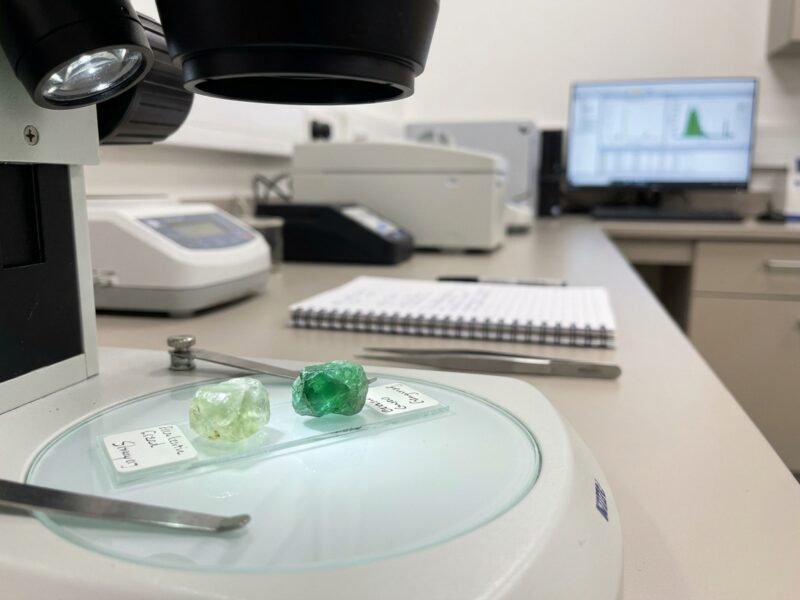

Every emerald owes its colour to a trace element present in concentrations measured in parts per million. Remove that element and you have colourless beryl — beautiful, but mineralogically unremarkable. Add it, and a geological accident produces one of the most coveted colours in the natural world. The element in question is almost always chromium, vanadium, or some combination of both. Which one is present, and in what ratio, determines not just the look of a stone but how laboratories classify it, how trade descriptions apply, and — at the finest grades — how much a buyer will pay.
Colour from Chemistry: How Green Happens
Beryl in its chemically pure state — Be₃Al₂Si₆O₁₈ — is transparent and colourless. Colour arises when trace elements enter the crystal lattice during growth, substituting for aluminium ions and altering how the crystal interacts with light. Different elements absorb different wavelengths. The ones that pass through reach the eye as colour.
Chromium (Cr³⁺) absorbs strongly in the violet-blue and yellow-red portions of the visible spectrum, transmitting a band of wavelengths centred around 530–560 nm — the green we associate with the finest Colombian and Zambian stones. This absorption is intense, which is why even tiny concentrations of chromium — typically 0.1% to 0.5% by weight — produce an unmistakably vivid, saturated result. The colour response of chromium in beryl is among the strongest of any element-to-gemstone combinations known to gemmology.
Vanadium (V³⁺) produces a similar but spectrally distinct absorption. The transmitted band shifts slightly toward 520–545 nm — cooler, sometimes described as slightly more blue-green than chromium-dominated stones. The effect is measurable by spectroscopy but, to the unaided eye under normal lighting, the difference is subtle. A skilled buyer can often sense it; a spectroscope confirms it.
Iron (Fe²⁺/Fe³⁺) is the third colorant that appears in beryl, though it produces distinctly different results. Where chromium and vanadium generate warm, pure greens, iron introduces a blue-green or yellowish tint and tends to reduce saturation. Most emeralds contain some iron alongside the primary colorant — the balance between them is one of the principal reasons why emeralds from different deposits look different even before origin is confirmed.
The warm, intensely saturated green of a fine Colombian stone is not a preference — it is a direct optical consequence of chromium-dominant absorption chemistry.
Chromium vs Vanadium: The Classification Debate
Whether vanadium-coloured beryl qualifies as emerald is one of the longest-running debates in applied gemmology. The dispute is not academic — it affects trade values, laboratory reports, and the legal accuracy of descriptions used in international commerce.
The traditional position, still used by some European laboratories, requires the presence of chromium as a condition of the emerald designation. Under this definition, a stone coloured solely by vanadium — regardless of how green it appears — is properly described as green beryl, not emerald. The commercial implication is significant: emerald commands a premium that green beryl does not.
The modern position, adopted by GIA and most major international laboratories, accepts vanadium as a qualifying colorant. Under this framework, a stone is emerald if it meets the colour saturation threshold and contains chromium, vanadium, or both in sufficient concentration. The rationale is practical: the optical result — a saturated green — is the same regardless of which element produces it, and the trade value should reflect the colour, not the colorant.
For buyers, the practical implication is straightforward: check which standard the issuing laboratory applies. A stone certified by a laboratory using the chromium-only definition and still described as emerald has passed a stricter test. A stone from a laboratory using the inclusive definition should be examined to understand whether its green arises from chromium, vanadium, or a mix — the answer affects how its colour will compare to Colombian material under different lighting conditions.
Colorant Profiles by Origin
Different deposits produce reliably different colorant fingerprints. The following overview describes the typical colorant chemistry of the major commercial origins — recognising that individual stones vary, and that mixed colorant profiles are common.
| Origin | Primary Colorant | Secondary Colorant | Typical Hue | Iron Influence |
|---|---|---|---|---|
| Colombia (Muzo/Coscuez) | Chromium | Vanadium (minor) | Pure to slightly yellowish-green | Very low — defining characteristic |
| Colombia (Chivor) | Chromium | Vanadium (minor) | Slightly bluish-green | Low — slight cool shift |
| Zambia (Kafubu) | Chromium | Vanadium | Vivid bluish-green | Moderate — contributes cool saturation |
| Brazil (Itabira) | Vanadium | Chromium (minor) | Light yellowish-green | Low — slight warm shift |
| Afghanistan (Panjshir) | Chromium | Vanadium | Vivid green, high saturation | Very low |
| Zimbabwe (Sandawana) | Chromium | — | Intense deep green | Very low — pure chromium signal |
The table illustrates why origin determination is not simply about identifying the deposit — it is about understanding the geochemical environment that produced the stone’s colour. A Zambian emerald and a Colombian emerald can appear superficially similar to a casual observer, but their colorant chemistry, and therefore their spectroscopic signatures, are measurably different. Laboratory origin reports are, in significant part, an interpretation of those chemical differences.
What the Hue Range Means for Buyers
The practical consequence of colorant chemistry is colour appearance — and colour is, at every level of the market, the single most important determinant of value. Understanding why a stone looks the way it does allows a buyer to evaluate it accurately rather than respond to it subjectively.
Three dimensions of colour matter in emerald grading: hue, tone, and saturation. Hue describes the position on the colour wheel — ranging from yellowish-green through pure green to bluish-green. Tone describes depth, from very light to very dark. Saturation describes intensity or purity of colour, from dull and grey-modified to vivid. A top-grade Colombian emerald typically sits at pure green to slightly bluish-green in hue, medium to medium-dark in tone, and vivid in saturation. The absence of grey or brown modifiers — which arise when iron competes with the primary colorant — is what separates a fine stone from a commercial one.
Buyers who understand colorant chemistry can read trade descriptions and laboratory reports with greater confidence. When a Gübelin or GIA report describes a stone as showing chromium-dominant absorption with minor vanadium, that is a direct statement about the geochemical source of the colour — and an indirect statement about the likely character of the hue. It will be warm, vivid, and towards the pure-green end of the spectrum. When a report notes significant iron alongside chromium, expect a cooler, more saturated result — often beautiful in Zambian material, but different in character from the Colombian warm-green benchmark.
Colour preference is partly personal — but it is also grounded in chemistry. Knowing which elements are responsible for a stone’s green allows a buyer to evaluate it, not just admire it.
Why Laboratories Use Colorant Data in Origin Determination
Major gemmological laboratories — GIA, Gübelin, SSEF, ICG — use trace element chemistry as one of the primary tools for establishing origin. The rationale is straightforward: each deposit has a geologically constrained trace element fingerprint, shaped by the local rock chemistry and hydrothermal fluid conditions. Colombian material from the black shale environment shows characteristically low iron relative to chromium. Zambian material shows higher iron. Brazilian vanadium-dominant stones have a fundamentally different chromium-to-vanadium ratio.
These differences are consistent enough that, when combined with inclusion data — the fluid inclusions and mineral assemblages visible under magnification — they allow experienced laboratories to assign origin with a high degree of confidence. The colorant profile is not the only data point used, but it is one of the most quantitative and reproducible. A stone that claims Colombian origin but shows a Zambian-type iron-to-chromium ratio will face scrutiny. The chemistry must be consistent with the claimed provenance.
LA-ICP-MS analysis measures dozens of trace elements simultaneously, producing a chemical fingerprint that extends well beyond colorants. Elements including beryllium, caesium, rubidium, scandium, and lithium all vary systematically between deposits. Colorant ratios — particularly Cr/V and Fe/(Cr+V) — form part of a multi-element discriminant analysis that laboratories apply to origin questions. No single element is definitive; the pattern across the full profile is what matters.
The Colombian Advantage: Chromium in a Low-Iron Environment
The defining characteristic of Colombian emerald colour — the warm, pure, intensely saturated green that defines the trade benchmark — is a direct consequence of geology. The black carbonaceous shales that host Colombia’s Eastern Andean deposits are unusually low in iron compared to the schist-hosted deposits of Zambia or Zimbabwe. This means that chromium, the primary colorant in Colombian stones, operates without significant iron competition. The result is an absorption profile that maximises the warm-green transmission band with minimal blue or yellow modification.
This is why Colombian stones — particularly those from Muzo — are described by the trade as having a characteristic warmth or life that other origins do not replicate. It is not mysticism. It is a measurable consequence of having chromium as the dominant colorant in a host rock environment that imposes very little iron competition. When the finest Muzo material also shows the optical phenomenon known as gota de aceite — an internal luminosity caused by the specific density of growth inclusions — the result is a stone that no other origin and no laboratory synthesis can reproduce.
For buyers, this translates to a clear framework: the closer a stone’s colorant profile is to chromium-dominant, low-iron Colombian chemistry, the closer it sits to the trade’s absolute colour ideal. That is why Colombian origin commands a premium — not as a brand preference, but as a direct consequence of the chemistry that the geological environment produces.