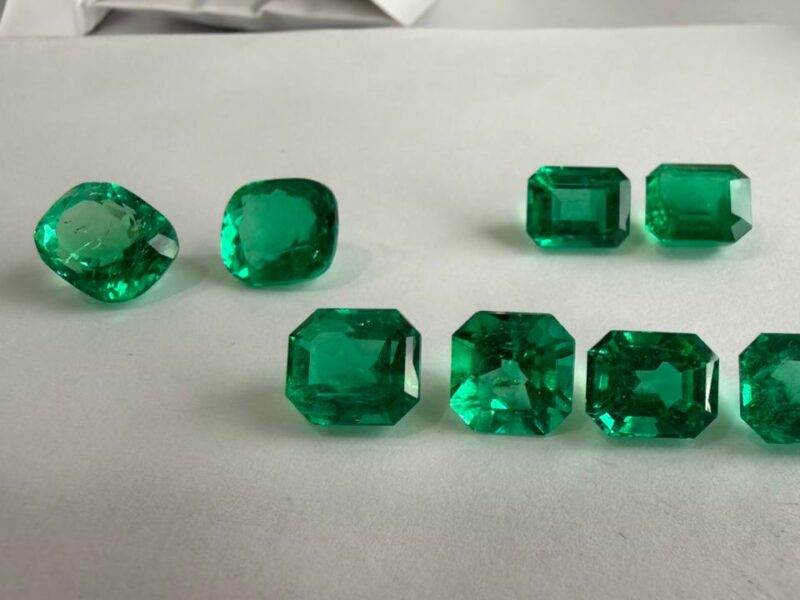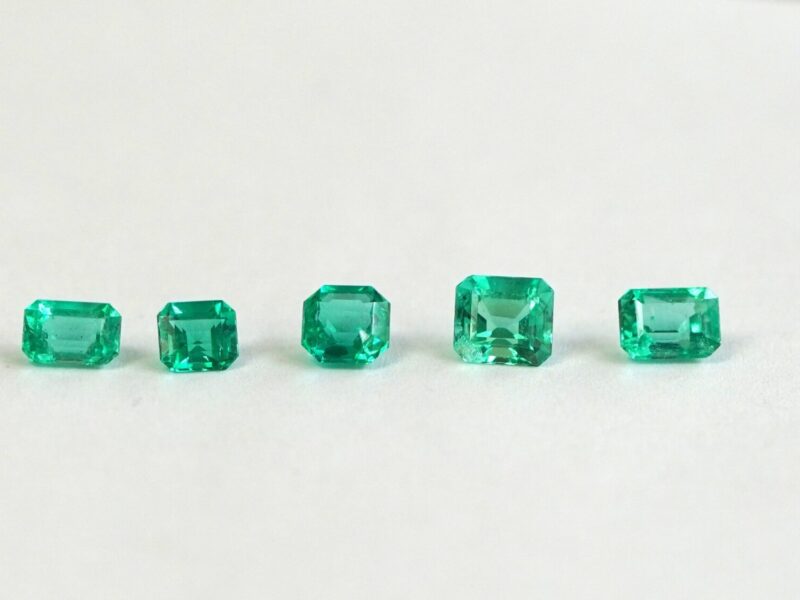

Emeralds form when beryllium-rich fluids from deep granite meet chromium-bearing rocks — a geological coincidence so rare it occurs in fewer than 20 places on Earth. The process requires three simultaneous conditions, takes between 32 and 65 million years, and produces gem-quality crystals only under exceptionally specific chemical circumstances.
Most people who own an emerald have never stopped to consider what they are actually holding. Understanding how emeralds are formed changes that permanently. An emerald is not simply a green stone mined from the ground. It is the product of three entirely separate geological events — each rare on its own — that had to converge in precisely the same place, at the same time, over tens of millions of years. The fact that they occasionally do is one of geology’s most extraordinary coincidences, and it is the entire scientific foundation for everything the emerald trade values.
This guide covers the complete science of emerald formation: what emeralds are at the mineral level, the precise conditions required for emerald crystal formation, why Colombia’s Eastern Andes produced the finest deposit ever discovered, and what emerald formation geology means for every stone on a jeweler’s tray today.
What Is an Emerald? The Mineralogy of Emerald Formation
Before asking how emeralds are formed, it helps to understand what they are. An emerald is a chromium- or vanadium-colored variety of the mineral beryl — a beryllium aluminium cyclosilicate with the chemical formula Be³Al²Si&sup6;O¹&sup8;. In its pure state, beryl is entirely colorless. The vivid green that defines an emerald comes from trace amounts of chromium (Cr), vanadium (V), or both, incorporated into the crystal lattice during growth.
This sounds straightforward. The emerald formation geology that makes it possible is anything but. Beryllium is one of the rarest elements in the Earth’s crust that actually forms minerals. Chromium is also relatively scarce — and critically, it concentrates in geological environments that are chemically hostile to beryllium-rich granite. For emerald crystal formation to begin, these two incompatible geological worlds must be forced together. In most of the Earth’s crust, they never are.
The geological improbability of emerald formation is not a marketing story — it is a mineralogical fact. Emerald deposits of any quality exist in fewer than 20 locations on Earth. Gem-quality deposits that produce commercially significant material number far fewer.
The Three Conditions Required for Emerald Crystal Formation
Gemologists and geologists identify three distinct conditions that must be present simultaneously for emerald crystal formation to occur. Meeting one or two is relatively common. Meeting all three in sufficient concentration to produce gem-quality material is the geological exception that makes fine emeralds genuinely rare.
Beryllium concentrates almost exclusively in granitic pegmatites — coarse-grained igneous rocks that crystallize slowly from silica-rich magma deep in the Earth’s crust. These pegmatites grow enormous crystals of beryl, but almost never gem-quality emerald. The colorant is absent.
Chromium and vanadium originate in mafic and ultramafic rocks — basalts, peridotites, ancient oceanic crust — that are chemically the opposite of beryllium-bearing granite. Under normal geological conditions, they never share the same space as beryllium.
Tectonic collision, hydrothermal fluid movement, or metamorphic transformation must force these chemically incompatible environments into contact. Even when this happens, gem-quality emerald crystal formation requires the right temperature, pressure, fluid chemistry, and time.
Where Are Emeralds Formed? The Major Geological Environments
Hydrothermal vein deposits — Colombia (the world benchmark)
Colombia’s Eastern Andes host the most important emerald formation environment on Earth: black carbonaceous shales deposited in an ancient marine environment more than 100 million years ago. These sedimentary rocks are unusually rich in organic carbon. During the Andean orogeny — the mountain-building event that began approximately 65 million years ago — tectonic forces opened fractures in the shale sequence and drove hot, saline brines upward from the granitic basement below. These hydrothermal fluids carried dissolved beryllium leached from the granite.
As the fluids migrated through the carbon-rich shale, they encountered chromium and vanadium released from organic matter in the sediment. The result is emerald crystals growing within calcite veins in black shale: a host rock environment found at no other major emerald locality in the world.
This unique emerald formation geology is directly responsible for three characteristics exclusive to Colombian stones: the three-phase inclusions of the jardin, the chromium-dominant color that produces the trade’s most vivid greens, and — in the finest Muzo production — the optical phenomenon called gota de aceite.
Schist-hosted metamorphic deposits — Zambia and Zimbabwe
The Kafubu district in Zambia, the world’s second most commercially significant emerald source, hosts emerald formation in biotite schist — metamorphic rock formed when ancient sediments experienced extreme heat and pressure. Zambian emeralds typically show higher natural clarity than Colombian stones and a slightly cooler, more blue-green hue due to higher iron content. Fine Zambian material is commercially significant, but the Colombian formation environment and its resulting color standard remain the benchmark the trade measures everything against.
Pegmatite-contact deposits — Brazil and Afghanistan
Brazil’s emerald deposits and Afghanistan’s Panjshir Valley stones form at contact zones between chromium-bearing ultramafic rocks and beryllium-rich granitic pegmatites. Brazilian material typically shows a lighter, more yellowish-green hue. Afghan Panjshir material can achieve exceptional color but is typically heavily included. Neither source competes consistently with Colombia at the highest quality grades.
| Colombia | Zambia | Brazil | Zimbabwe | |
|---|---|---|---|---|
| Host rock | Black shale | Biotite schist | Ultramafic contact | Biotite schist |
| Formation type | Hydrothermal vein | Metamorphic | Pegmatite contact | Metamorphic |
| Formation age | 32–65 million yrs | 450–500 million yrs | 500–600 million yrs | 2.7 billion yrs |
| Primary colorant | Chromium + vanadium | Cr + V + iron | Chromium + vanadium | Chromium |
| Typical hue | Vivid warm green | Slightly bluish-green | Light yellowish-green | Vivid green |
| Natural clarity | Moderate (jardin) | Good to high | Moderate | Good |
| Market position | Premium benchmark | Strong second tier | Commercial | Specialty |
Why Colombian Emerald Formation Produces a Different Gemological Object
Chromium dominance — the source of ‘Colombian green’
Colombian emerald formation releases chromium in concentrations and chemical forms that other environments do not match. Chromium absorbs light simultaneously in the yellow and blue portions of the spectrum, leaving a uniquely pure, warm, intensely saturated green. This is the direct optical result of the sedimentary formation chemistry — confirmed spectroscopically by GIA and Gübelin research across decades of origin studies. The ‘Colombian green’ trade benchmark is not a preference: it is a geochemical measurement.
The jardin — a geological fingerprint unique to Colombian formation
Because Colombian emerald formation occurs in a sedimentary environment with active hydrothermal fluid circulation, Colombian stones characteristically contain three-phase inclusions: microscopic cavities simultaneously holding a solid mineral crystal, a liquid brine, and a gas bubble. These inclusions — the emerald’s jardin — are direct evidence of the formation environment. Gemological laboratories use them as primary confirmation of Colombian origin.
In the emerald market, the jardin is not a flaw to be minimized — it is the authentication mechanism that no laboratory synthesis can replicate. The jardin is the geological document that confirms 65 million years of natural formation.
Gota de aceite — the optical signature of finest Muzo material
The finest production from the Muzo mine exhibits a phenomenon called gota de aceite — ‘drop of oil’ in Spanish. This optical effect is produced by the specific density and distribution of microscopic inclusions in the finest Muzo crystals, scattering light in a way that gives the stone an internal silkiness or liquid quality. It exists in no other gemstone from any other source. No photograph captures it.
How Long Does It Take for an Emerald to Form?
For Colombian material, the answer is between 32 and 65 million years. Emerald formation in the Eastern Andes occurred during two main episodes of tectonic activity — one approximately 38 million years ago, another around 32 million years ago — driven by the ongoing Andean uplift that began 65 million years ago.
Individual crystals grew over periods of tens of thousands to millions of years. The stones being extracted at Muzo and Chivor today began their formation before the Himalayas existed, before the continents reached their current positions, before the climate of the modern Earth was established.
That context is not merely interesting. It is the complete answer to why Colombian emeralds are rare: the formation process cannot be accelerated or recreated. The Colombian deposits are finite. Every mine extraction makes the next extraordinary stone more scarce — not less.
What Emerald Formation Means When You Buy
When a laboratory confirms Colombian origin, it is confirming a specific formation environment that produces measurable, documented differences in color, inclusion character, and optical properties. The premium reflects consistent quality differential — not national branding.
The inclusion landscape produced by Colombian emerald formation geology confirms natural geological origin in a way no synthetic or treated stone can replicate. Understanding what inclusions represent changes how any informed buyer evaluates clarity in emeralds versus diamonds.
The conditions that produced the Colombian deposits cannot be recreated. The Muzo and Chivor deposits are finite. The finest material will become scarcer over time.
Frequently Asked Questions
How are emeralds formed in nature?
Emeralds form in nature when beryllium-bearing hydrothermal fluids from granite encounter chromium- or vanadium-bearing rocks. In Colombia, this happens in fractured black shale through which beryllium-bearing brines migrate upward from a granitic basement, encountering chromium from organic matter in the sediment. Elsewhere — Zambia, Zimbabwe, Brazil — it happens in metamorphic or igneous contact environments, each producing stones with different characteristics.
How long does it take for an emerald to form?
Colombian emeralds began forming approximately 32–65 million years ago, during tectonic episodes associated with the Andean uplift. Individual crystals grew over periods of tens of thousands to millions of years. Emerald formation cannot be significantly accelerated in nature — the time is required for sufficient crystal growth to produce cuttable gem-quality material.
Why are Colombian emeralds so rare and valuable?
Colombian emeralds are rare because their formation environment — hydrothermal veins in black carbonaceous shale in the Eastern Andes — is the only environment of its kind at commercial scale anywhere on Earth. This unique formation geology produces consistently higher chromium concentrations than other sources, generating the vivid, warm green saturation that defines the global trade benchmark. The deposits are finite and have no confirmed replacement source.
Where are emeralds formed geologically?
Emeralds form in three main geological settings: hydrothermal vein deposits in sedimentary rock (Colombia — the global benchmark), schist-hosted metamorphic deposits (Zambia, Zimbabwe), and pegmatite-contact zones where granite meets ultramafic rock (Brazil, Afghanistan). Colombian formation in black shale is unique among these environments.
Can emeralds be formed in a laboratory?
Yes — synthetic emeralds can be grown hydrothermally in a laboratory. Laboratory-grown emeralds share the same chemical formula as natural stones and typically achieve higher clarity. However, synthetic emeralds lack the characteristic jardin — particularly the three-phase inclusions diagnostic of Colombian origin — and are distinguishable from natural stones by trained gemologists. Natural Colombian emeralds command significant premiums because of their geological origin, finite supply, and historical significance.