Muzo: The Real Story Behind the World’s Finest Emeralds
A Mine That Predates the Word “Colombia”
The people who first mined this ground weren’t looking for a gemstone to sell. The Muisca and the Muzo were a distinct, fiercely independent people. The Spanish would later name the region after them. They had worked these deposits for centuries before a European ever set foot in the Andes. Emeralds moved through indigenous trade networks that stretched across the continent. The value had nothing to do with the market price we now attach to carats and clarity grades.
That distinction matters, because it means Muzo’s emerald history didn’t begin with an act of discovery. It began with an act of taking.
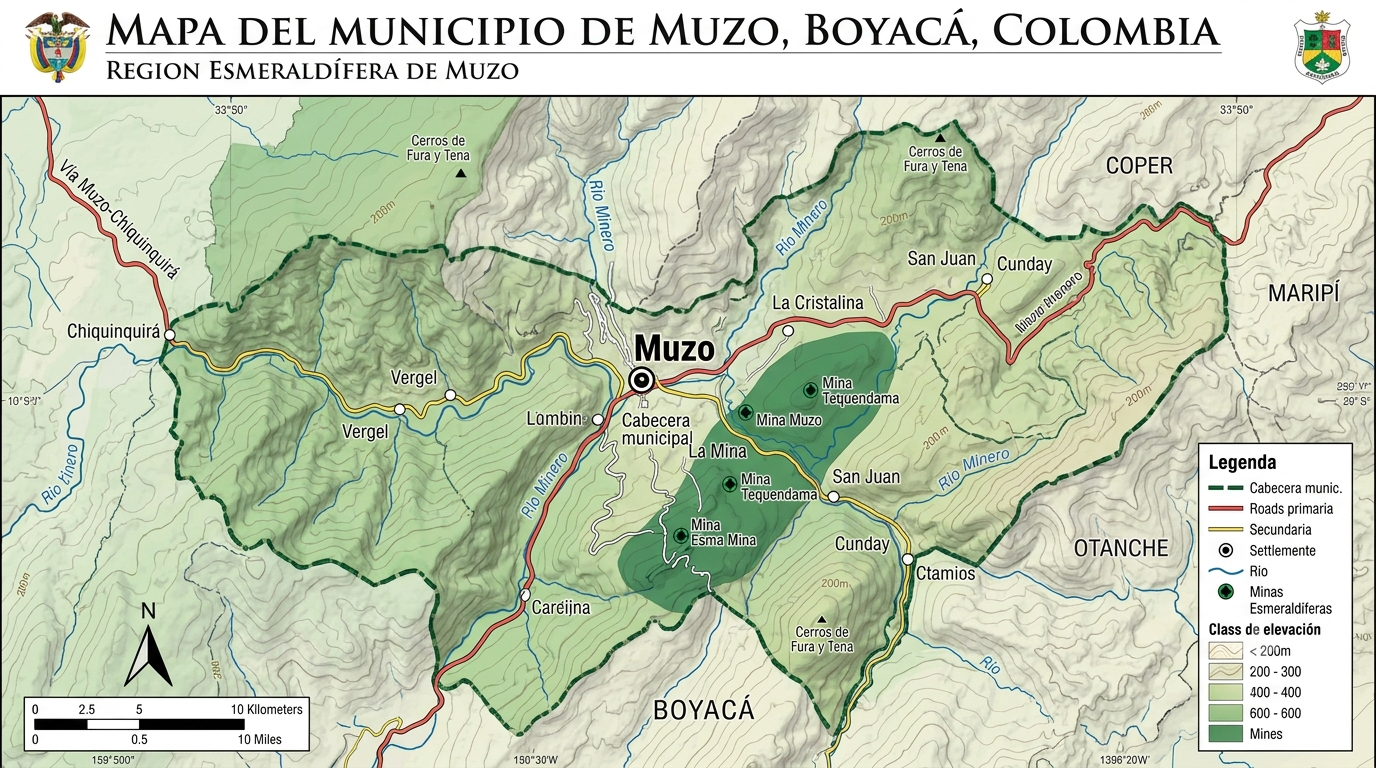
The Boyacá highlands, roughly 200 km north of Bogotá — terrain that made this region hard to reach and, for a long time, harder to conquer.
Four Failed Expeditions and a Secret Worth Keeping
When Spanish conquistadors pushed into the region in the 1530s, they were chasing gold. It was the same fever that drove expeditions across the whole continent. What they found instead was different: emerald of a quality Europe had never seen, in the possession of the people they were fighting. Captain Luis Lanchero led an expedition into Muzo territory in 1538. It failed. So did the ones that followed in 1545, 1550, and 1551. The Muzo people knew exactly what the Spanish were after. For years, they simply refused to give up the location of the source.
Conquest, and What Came After
It took until 1558 for Spanish forces to finally locate and take control of the mines. The Muzo had worked them for generations. By 1560, the Spanish had founded a colonial town on the site: Villa de la Santíssima Trinidad de los Muzos. It came complete with a church and the administrative apparatus of occupation. What followed was decades of forced indigenous labor. Workers extracted emeralds bound for the Spanish crown and European royalty. Some, through remarkably far-reaching trade routes, even reached Mughal rulers in India. The human cost was severe. Eventually Philip III of Spain issued a royal decree intended to protect the surviving indigenous population. It came only after the worst of the damage had already been done.
This is the part of the story that’s easy to sand down into a simpler, more romantic version “ancient mines, legendary stones.” The real version is a colonial extraction economy built on the backs of a people who had already been mining this ground for their own reasons, long before it had a price attached to it.
The mines have operated, in one form or another, almost continuously since the 1560s.
Independence, and a Slow Drift Toward Chaos
When Colombia won independence in 1819, ownership of the Muzo mines passed from the Spanish crown to the new nation. In practice, “national ownership” meant decades of the mines shifting between public control and private lease. Sometimes Colombian operators held them; sometimes European ones did. For the first time, emeralds began moving directly from Muzo to the jewel houses of Paris and London. They no longer had to pass exclusively through Spain. But formal state control over such a remote, mountainous region stayed thin. Alongside the licensed operations, informal independent miners, known as guaqueros, worked the margins of these deposits for generations. They sifted through mine tailings and unofficial digs for whatever they could find.
That informal economy was legalized in 1953. But legal status didn’t come with a functioning system for resolving disputes. Miners and mine-owning families were largely left to settle conflicts over territory themselves.
The Green Wars
What followed is the darkest chapter of this history, and the most widely known. We’re not going to soften it. Beginning in the 1960s and escalating through the 1980s, rival mining families fought for control of the region’s most productive ground. By the mid-1980s, drug trafficking money and organizations had become entangled with the conflict too. The draw was the same thing that had always drawn outsiders here: a resource worth fighting over, in a place remote enough that the fighting could go largely unchecked. Estimates of the death toll from this period, commonly called the Green Wars, run into the thousands.
The Peace, and What Came After It
It ended, in large part, through the intervention of the Catholic Church. In 1991, the surviving leaders of the region’s mining families signed a peace accord. Colombian bishops mediated it, with civil and military authorities present as witnesses. It held. The decades since have seen a genuine, if gradual, shift toward formalization. Modern mining companies now operate with employment contracts, safety standards, and community investment in a region that spent much of the 20th century defined by the opposite of all three.
What This History Actually Means for the Stone in Your Hand
We’re telling you this because a certificate that just says “Muzo, Colombia” flattens five centuries into two words. We don’t think that’s honest. When you’re evaluating a Muzo emerald, you’re weighing its color, its jardin, its cut. You’re not evaluating an abstract mineral specimen. You’re looking at the product of a specific place with a specific, complicated, still-unfolding history worked first by people who understood it long before anyone called it valuable.
This is also, practically, why direct sourcing and real documentation matter to us beyond the certification paperwork. A stone with a properly traced chain of custody isn’t just a compliance requirement. It’s a way of actually knowing which part of this long, difficult history the stone in front of you came from. It’s how we buy from operations that are part of the region’s genuine formalization, rather than its unresolved past.
The region today — a slow, real shift toward transparency and formal employment.
Common Questions
Who mined Muzo before the Spanish arrived?
The Muisca and Muzo peoples worked these emerald deposits for centuries before European contact. They traded the stones through indigenous networks that extended well beyond present-day Colombia.
What were the “Green Wars”?
A period of violent conflict over control of Colombia’s emerald mines, escalating through the 1980s and ending with a 1991 peace accord mediated by the Catholic Church. It’s a real and serious part of the region’s history one the industry has spent the decades since actively moving away from.
Is Muzo mining still informal or dangerous today?
The industry has shifted substantially toward formal operations since the 1991 peace accord, especially over the past decade. Licensed employment, safety standards, and traceable supply chains are now the norm among established operators. This is best confirmed per source, which is exactly what direct partnership and certification documentation are for.
An emerald is what happens when two elements that almost never meet end up in the same place at the same time. The base mineral is beryl the same family that produces aquamarine and morganite. On its own, beryl has no color. It takes trace amounts of chromium, and sometimes vanadium, bleeding into the crystal as it forms, to turn it green. Chromium is common in the earth’s crust. Beryllium, the element beryl needs to exist at all, is not. In most of the world, the rock that carries chromium and the rock that carries beryllium simply never touch.
Colombia is the exception, and the reason has more to do with plumbing than geology in the usual sense. The Eastern Cordillera, where Muzo, Chivor, and Coscuez sit, holds thick beds of black shale. Millions of years ago, sedimentary layers built this rock, rich in organic material and, crucially, in the trace metals emeralds need. Hot, mineral-saturated water moved up through cracks in that shale. It dissolved what it passed through and carried it toward the surface. Where that fluid found a cavity and slowed down, it deposited what it was carrying. Where the chemistry lined up, that deposit crystallized as beryl, with just enough chromium trapped inside to turn it green.
This is why Colombian emeralds carry a color character that other mining regions don’t fully replicate Zambia, Brazil, and the historical Egyptian and Austrian deposits all involve different host rock. The chemistry differs too. And this hydrothermal origin explains something more practical: an emerald from a vein deposit like this almost always carries some internal texture. The same slow, turbulent process that grew the crystal also trapped fragments of the fluid, and sometimes the surrounding rock, inside it as it grew.
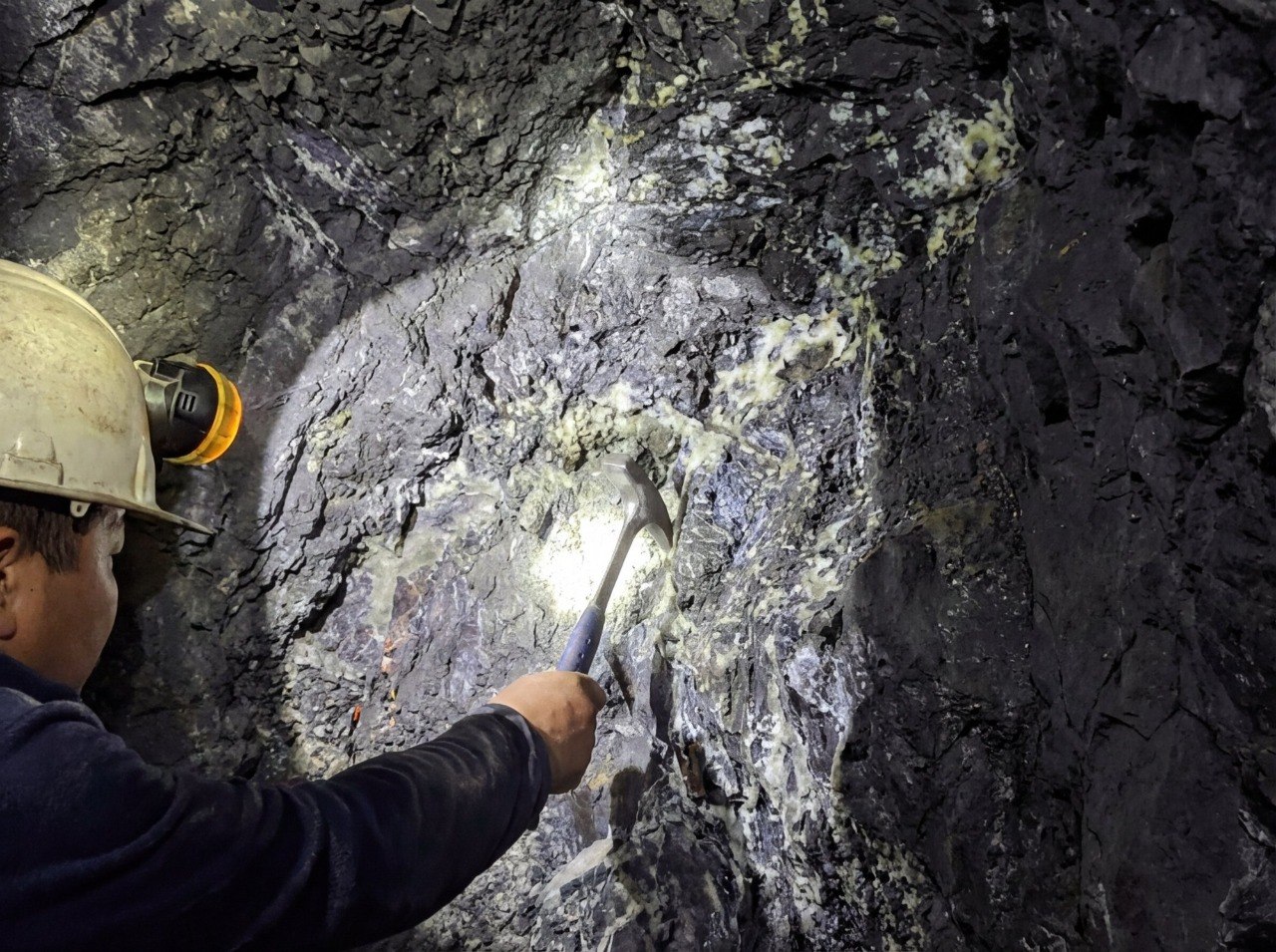
– Mining the emeralds in Muzo
Why this matters for how you evaluate a stone: almost everything a buyer later judges the internal texture we cover in the Jardin article, the color saturation covered in the Four Cs traces back to this stage. You’re not evaluating flaws against some external ideal. You’re reading the specific conditions that particular pocket of shale created, millions of years before anyone owned the stone.
The Rough Stone Decides Its Own Cut
A rough emerald crystal grows as a hexagonal prism six flat sides around a central axis, the natural geometry of the beryl structure. No cutter imposes that shape; it’s simply how the atoms stack. The cutter’s real job is to study that hexagon, weigh everything trapped inside it, and decide how much of the crystal can become a finished stone without destroying what made it valuable in the first place
This is where the “emerald cut” the rectangular step-cut so associated with the stone that it borrowed the gem’s name actually comes from. Cutters didn’t choose it for style alone. Emeralds are structurally more fragile than diamonds. The same inclusions that give a stone its character also make it more prone to chipping under stress, especially at sharp facet junctions. A step cut, with its long parallel facets and clipped corners, distributes pressure more evenly across the stone and protects it during both cutting and everyday wear. A round brilliant cut, with its many small facets converging at sharp points, carries far more risk on an emerald so cutters use it far less often, for exactly that reason.
But the hexagonal rough doesn’t map neatly onto a rectangle. A cutter has to work around visible inclusions. They also account for natural color zoning many rough crystals run noticeably deeper in color at one end than the other. And they watch for internal fractures that would only worsen under the stress of faceting. This is why two rough stones of identical weight can yield finished emeralds of very different shapes: heart, trillion, cushion, baguette, asscher. Each shape is the result of a cutter reading that individual crystal and deciding what shape keeps the most weight and the least risk. Nobody imposes the cut on the stone. The cutter negotiates it, crystal by crystal.
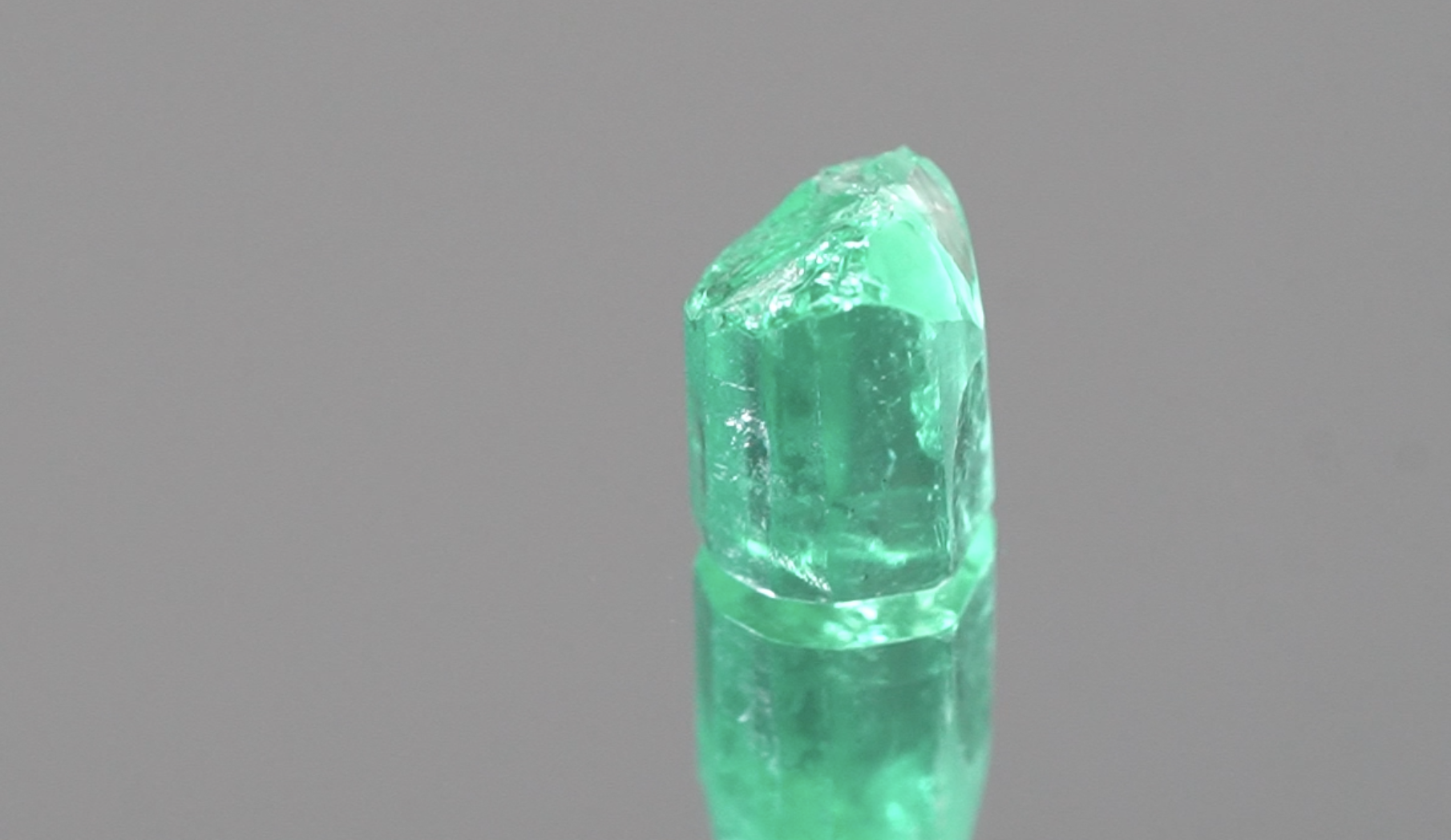
From hexagonal rough to finished shape — the cutter’s job is reading each individual crystal, not applying a fixed template.
Treatment: The Step Nobody Skips, and Why That’s Normal
Here’s something worth saying plainly, because people often treat it as a secret rather than an industry standard: the overwhelming majority of emeralds on the market, including fine ones, undergo treatment. Specifically, dealers oil them a practice going back centuries, older than most of the certification bodies now grading around it.
Emeralds form with surface-reaching fractures as a natural consequence of the process we just described. The same internal stress that makes careful cutting necessary also leaves most rough crystals with tiny fissures reaching the surface. Left alone, these fractures scatter light. They make the stone look duller and more included than its actual color and clarity would suggest.
What Oiling Actually Does
Oiling fills those fractures with a clear substance traditionally cedar oil, since its refractive index closely matches beryl’s. This lets light pass through more evenly, and lets the stone’s true color and transparency show. It isn’t disguising a flaw the way filling a diamond’s fracture with glass might read to a buyer. It’s closer to decanting a wine, or oiling fine furniture to bring out grain that was always there.
What Actually Matters: Degree, Not Presence
What actually matters and what any reputable seller should tell you outright is the degree of treatment. The industry grades this on a scale: “no oil” or “minor” treatment sits at one end, rare, and sellers price it accordingly. “Moderate” and “significant” treatment follow. A heavily treated stone isn’t fraudulent, but sellers should price and disclose it as what it is. This is exactly what an ICG certificate documents. It’s why every stone in our collection carries a treatment grade on its certification, rather than a vague assurance.
From Mine to the Stone You’re Actually Looking At
By the time a finished emerald reaches a trade buyer, it has already passed through geology it had no say in. It has passed through a cutter’s judgment call about its own rough shape, and a treatment decision that determines how it presents. None of that is incidental. It’s the actual chain of custody that determines value. That’s why we document origin, cut rationale, and treatment grade on every stone we source, rather than treating the finished product as if it simply arrived that way.
This is also, practically, why sourcing directly from Colombian mine partnerships matters more than it might seem. A stone that passes through several intermediaries before reaching a buyer usually loses the specific information that explains what you’re looking at — which mine, what the rough looked like, why the cutter chose this shape over another. That’s the gap direct sourcing closes.
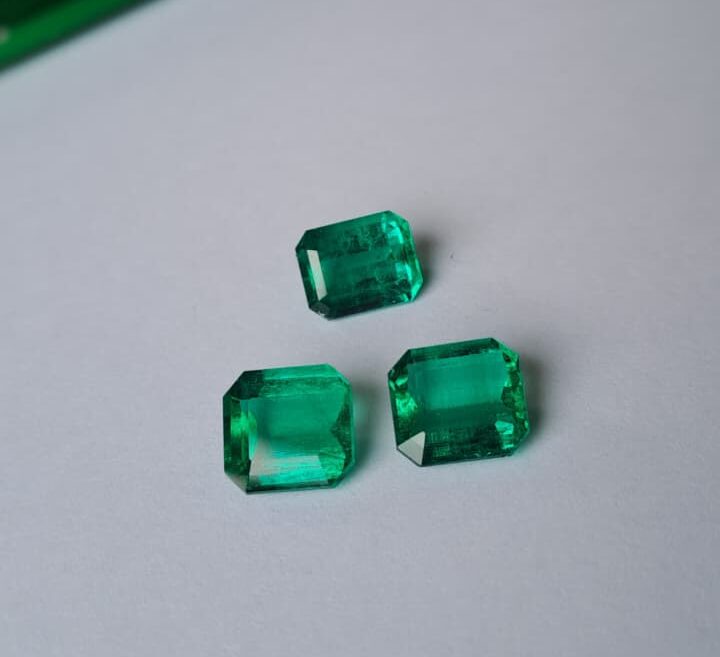
The finished stone — the end of a process that started with chemistry no one engineered.
Common Questions
Why do Colombian emeralds have a different color than emeralds from other countries?
Colombian emeralds form in black shale via hydrothermal fluid deposits, a geological setting almost unique to Colombia. Most other major deposits (Zambia, Brazil) form in schist through a different process, which affects the trace chemistry and typically produces a different color character.
Is it true that almost all emeralds are treated?
Yes — oiling to fill natural surface-reaching fractures is standard industry practice and has been for centuries. What matters is the degree of treatment and whether it’s honestly disclosed, which is exactly what a proper certification documents.
Why are so many emeralds cut in the rectangular “emerald cut” shape?
The step-cut’s flat, elongated facets distribute stress more evenly across the stone than a brilliant cut would, which matters because emeralds are more prone to chipping than harder gemstones. It’s a structural choice as much as an aesthetic one.
“Jardin” is French for garden, and gemologists didn’t reach for it by accident. Look through a fine Colombian emerald under magnification and you’ll see exactly why. There’s a tangle of fine, feather-like fractures, tiny mineral crystals, and delicate two- and three-phase inclusions, all catching light differently as you turn the stone. It genuinely does resemble looking into undergrowth. The industry could have called this “internal flaws,” the way diamond grading does. It chose a word for something worth looking at instead.
That choice of language isn’t sentimentality. It reflects a real difference in how emeralds are actually evaluated compared to other gemstones. It’s worth understanding both what’s really in there, and why it matters.
Viewed under magnification, the internal world of a Colombian emerald genuinely does resemble a garden — which is exactly where the term comes from.
What’s Actually Inside
A jardin is made up of several distinct things, not one uniform texture:
Mineral inclusions: tiny crystals of other minerals growing in the same environment, trapped as the emerald formed around them. In Colombian stones, these are commonly calcite, pyrite, or biotite mica. Each has its own characteristic look under magnification.
Fluid inclusions: microscopic pockets of the same mineral-rich liquid that carried the emerald’s chemistry to begin with, sealed inside as the crystal grew around them.
Three-phase inclusions: the most distinctive feature of Colombian material. These tiny sealed cavities hold liquid, a gas bubble, and a solid crystal (often a small cube of salt) together in one pocket. It’s a direct fingerprint of the hydrothermal fluid the stone formed from.
Healed fractures: fine feather-like patterns where a break in the growing crystal was later sealed back up by more mineral growth. It’s a visible trace of an event that happened millions of years before anyone owned the stone.
A three-phase inclusion — liquid, gas, and a solid crystal sealed together — is one of the clearest fingerprints of Colombian origin.
Why This Gets Valued Rather Than Penalized
There are two real reasons a jardin counts as part of an emerald’s character, not a defect to eliminate.
Reason One: It’s Proof
Synthetic emeralds are grown in a lab, chemically identical to natural stones. But they form under completely different conditions, and their internal texture reflects that. A flux-grown synthetic often shows characteristic feathery, wispy inclusions and a wax-like glow under certain lighting. A trained gemologist can recognize that as unnatural. A hydrothermal synthetic looks different again. Genuine three-phase inclusions of the kind Colombian emeralds carry are extremely difficult to fake convincingly. That means a well-developed jardin isn’t just tolerated it’s often read as active evidence the stone is exactly what it claims to be.
Reason Two: It’s the Stone’s Real History
The second reason is closer to how collectors think about patina on antique furniture, or terroir in a wine. A completely “clean” emerald with no internal character at all is, in this specific gem, actually the anomaly. The jardin is the visible signature of the stone’s real formation history: the specific pocket of Colombian shale it grew in, the fluid that carried its color, the pressure it survived. You can’t eliminate that without eliminating the emerald.
Where Jardin Crosses Into an Actual Problem
None of this means every level of inclusion is desirable. There’s a real difference between a jardin that gives a stone character while staying “eye-clean” meaning the inclusions don’t disrupt clarity or brilliance at a normal viewing distance and inclusions severe enough to compromise transparency, dull the color, or create genuine structural weak points that risk chipping.
This is exactly what a proper clarity grade on a certificate is assessing. The question isn’t “does this stone have a jardin” almost every genuine Colombian emerald does. It’s how developed the jardin is, and whether it affects the stone’s performance and durability. That’s a judgment call for a trained gemologist working from the actual stone, not a rule you can summarize in one sentence. It’s part of why every stone we offer carries its own documented clarity assessment, rather than a generic claim.
Common Questions
Does every real Colombian emerald have a jardin?
Almost all do, to some degree — it’s a natural byproduct of how the stone forms. Completely inclusion-free emeralds are extremely rare. They command a significant premium precisely because of that rarity.
Can a jardin help prove a stone is genuine?
Yes, in a real sense. Three-phase inclusions in particular are difficult to replicate synthetically. Gemologists look for them when distinguishing natural Colombian material from lab-grown or treated look-alikes.
Is a heavily included emerald worth less?
It depends on whether the inclusions affect transparency, brilliance, and structural durability — not just their presence. A moderate, eye-clean jardin is normal and doesn’t significantly reduce value. Inclusions severe enough to dull color or create fracture risk do.
The “Four Cs” framework was built for diamonds, where color is mostly about the absence of it the whiter, the better. Applied directly to emeralds, that framework breaks in useful ways. Emerald grading actually inverts several of the diamond rules. Nowhere does that cause more confusion than color and carat. Let’s take all four properly.
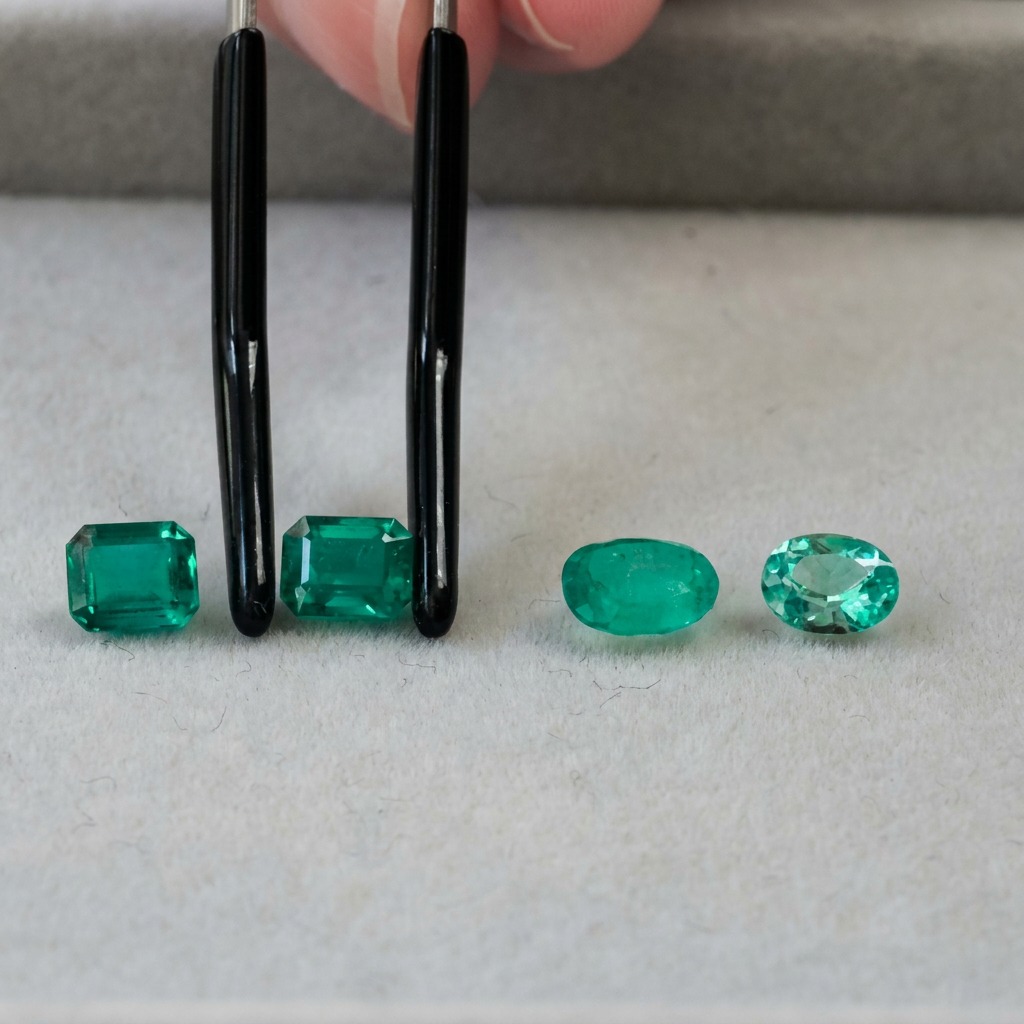
Same rough size class, genuinely different colors — this is what “color” is actually describing.
Color: Not One Thing, Three Things
“Green” tells you almost nothing about an emerald’s value. Gemologists actually break color down into three separate dimensions. A stone’s final assessment is the combination of all three, not any one of them alone.
Hue
Which family of green. Fine Colombian emeralds sit somewhere between pure green and blue-green, with a slightly bluish cast generally considered most desirable. Too far toward yellow-green and it starts reading as a different stone entirely.
Tone
How light or dark the color is, independent of the hue itself. Too pale and the stone looks washed out and weak. Too dark and it starts looking almost black in low light, losing brilliance. The sweet spot is medium to medium-dark.
Saturation
How vivid or muted the color is how much gray dilutes it. This is often the single biggest driver of price at a given hue and tone. Two stones can share the same green with wildly different intensity, and the vivid one commands a real premium.
A stone described in the trade as “vivid, slightly bluish-green, medium-dark tone” is naming a specific point on all three axes at once. It’s not just saying “nice green.” When you’re comparing two emeralds, ask which of these three is actually different between them. It’s rarely all three. Usually it’s one, and that one determines most of the price gap.
Clarity: Read the Jardin, Not a Diamond Standard
Diamond clarity grading assumes a “loupe clean” ideal is achievable and desirable. That standard doesn’t transfer to emeralds. As covered in depth in our article on the jardin, internal texture is close to universal in genuine Colombian stones. Clarity grading for emeralds really asks two questions. Is the stone eye-clean from a normal viewing distance? Do the inclusions compromise transparency or structural integrity, rather than simply being present? A stone can carry visible internal character under magnification and still grade very well that’s the honest baseline for this specific gem.
Cut: Negotiated With the Rough, Not Chosen Freely
We cover this in detail in our formation article, but here’s the short version: an emerald’s cut isn’t a stylistic preference imposed on the stone. The rough crystal’s natural hexagonal shape, its color zoning, and the location of its inclusions all constrain what shape a cutter can realistically produce. The goal is avoiding excessive weight loss or an unacceptable risk of chipping. The prevalence of the step-cut “emerald cut” comes specifically from that shape’s ability to distribute stress evenly across a structurally more fragile stone than diamond.
Same weight on the scale. Genuinely different size to the eye. This is what “carat isn’t size” actually looks like.
Carat: It’s a Weight, and That Distinction Actually Matters
This is the most misunderstood C, so worth being direct about it: a carat is a unit of weight (0.2 grams), not a unit of size. People use “carat” colloquially to mean “how big does it look.” But those two things can genuinely diverge, for reasons entirely within a cutter’s control.
Two Reasons Weight and Size Diverge
Two 1-carat emeralds can look noticeably different in size face-up, for two real reasons. First, density: emerald is less dense than diamond. A given weight of emerald simply occupies more physical volume than the same weight of diamond. A 1-carat emerald already looks larger face-up than a 1-carat diamond, purely because of the material itself. Second, and more important for comparing emerald to emerald: cut proportions. A shallow-cut stone spreads its weight closer to the surface, appearing larger from above for its weight. A deep-cut stone concentrates weight in the pavilion, below the surface. That adds carats to the certificate without adding anything visible once the stone is set in a ring. A cutter choosing a deeper cut to preserve weight from a challenging rough crystal will produce a technically heavier stone that looks smaller than a shallower-cut stone of lesser weight.
The practical takeaway: if visible size matters to you as much as the number on the certificate, ask for the stone’s measured dimensions — length, width, and depth — not just its carat weight. Two stones with the same carat figure are not interchangeable. This is exactly the kind of detail that gets lost when a buyer works from a spec sheet rather than the actual stone.
Common Questions
What’s the most important of the four Cs for emerald value?
Color, and specifically saturation, typically drives the largest swings in price at a given size. Two similarly sized stones with different color intensity can vary substantially in value.
Can two emeralds with the same carat weight look different sizes?
Yes, often noticeably so. Cut proportions determine how much of the stone’s weight is visible face-up versus hidden in the pavilion’s depth. Carat weight alone doesn’t tell you how large a stone will actually look when worn.
Does emerald clarity grading work the same way as diamond clarity?
No. Emeralds are graded against an “eye-clean and structurally sound” standard, not a loupe-clean ideal. That’s because internal inclusions, the jardin, are a near-universal, natural feature of genuine Colombian stones.
Every emerald owes its colour to a trace element present in concentrations measured in parts per million. Remove that element and you have colourless beryl — beautiful, but mineralogically unremarkable. Add it, and a geological accident produces one of the most coveted colours in the natural world. The element in question is almost always chromium, vanadium, or some combination of both. Which one is present, and in what ratio, determines not just the look of a stone but how laboratories classify it, how trade descriptions apply, and — at the finest grades — how much a buyer will pay.
Colour from Chemistry: How Green Happens
Beryl in its chemically pure state — Be₃Al₂Si₆O₁₈ — is transparent and colourless. Colour arises when trace elements enter the crystal lattice during growth, substituting for aluminium ions and altering how the crystal interacts with light. Different elements absorb different wavelengths. The ones that pass through reach the eye as colour.
Chromium (Cr³⁺) absorbs strongly in the violet-blue and yellow-red portions of the visible spectrum, transmitting a band of wavelengths centred around 530–560 nm — the green we associate with the finest Colombian and Zambian stones. This absorption is intense, which is why even tiny concentrations of chromium — typically 0.1% to 0.5% by weight — produce an unmistakably vivid, saturated result. The colour response of chromium in beryl is among the strongest of any element-to-gemstone combinations known to gemmology.
Vanadium (V³⁺) produces a similar but spectrally distinct absorption. The transmitted band shifts slightly toward 520–545 nm — cooler, sometimes described as slightly more blue-green than chromium-dominated stones. The effect is measurable by spectroscopy but, to the unaided eye under normal lighting, the difference is subtle. A skilled buyer can often sense it; a spectroscope confirms it.
Iron (Fe²⁺/Fe³⁺) is the third colorant that appears in beryl, though it produces distinctly different results. Where chromium and vanadium generate warm, pure greens, iron introduces a blue-green or yellowish tint and tends to reduce saturation. Most emeralds contain some iron alongside the primary colorant — the balance between them is one of the principal reasons why emeralds from different deposits look different even before origin is confirmed.
The warm, intensely saturated green of a fine Colombian stone is not a preference — it is a direct optical consequence of chromium-dominant absorption chemistry.
Chromium vs Vanadium: The Classification Debate
Whether vanadium-coloured beryl qualifies as emerald is one of the longest-running debates in applied gemmology. The dispute is not academic — it affects trade values, laboratory reports, and the legal accuracy of descriptions used in international commerce.
The traditional position, still used by some European laboratories, requires the presence of chromium as a condition of the emerald designation. Under this definition, a stone coloured solely by vanadium — regardless of how green it appears — is properly described as green beryl, not emerald. The commercial implication is significant: emerald commands a premium that green beryl does not.
The modern position, adopted by GIA and most major international laboratories, accepts vanadium as a qualifying colorant. Under this framework, a stone is emerald if it meets the colour saturation threshold and contains chromium, vanadium, or both in sufficient concentration. The rationale is practical: the optical result — a saturated green — is the same regardless of which element produces it, and the trade value should reflect the colour, not the colorant.
For buyers, the practical implication is straightforward: check which standard the issuing laboratory applies. A stone certified by a laboratory using the chromium-only definition and still described as emerald has passed a stricter test. A stone from a laboratory using the inclusive definition should be examined to understand whether its green arises from chromium, vanadium, or a mix — the answer affects how its colour will compare to Colombian material under different lighting conditions.
Colorant Profiles by Origin
Different deposits produce reliably different colorant fingerprints. The following overview describes the typical colorant chemistry of the major commercial origins — recognising that individual stones vary, and that mixed colorant profiles are common.
Origin
Primary Colorant
Secondary Colorant
Typical Hue
Iron Influence
Colombia (Muzo/Coscuez)
Chromium
Vanadium (minor)
Pure to slightly yellowish-green
Very low — defining characteristic
Colombia (Chivor)
Chromium
Vanadium (minor)
Slightly bluish-green
Low — slight cool shift
Zambia (Kafubu)
Chromium
Vanadium
Vivid bluish-green
Moderate — contributes cool saturation
Brazil (Itabira)
Vanadium
Chromium (minor)
Light yellowish-green
Low — slight warm shift
Afghanistan (Panjshir)
Chromium
Vanadium
Vivid green, high saturation
Very low
Zimbabwe (Sandawana)
Chromium
—
Intense deep green
Very low — pure chromium signal
The table illustrates why origin determination is not simply about identifying the deposit — it is about understanding the geochemical environment that produced the stone’s colour. A Zambian emerald and a Colombian emerald can appear superficially similar to a casual observer, but their colorant chemistry, and therefore their spectroscopic signatures, are measurably different. Laboratory origin reports are, in significant part, an interpretation of those chemical differences.
What the Hue Range Means for Buyers
The practical consequence of colorant chemistry is colour appearance — and colour is, at every level of the market, the single most important determinant of value. Understanding why a stone looks the way it does allows a buyer to evaluate it accurately rather than respond to it subjectively.
Three dimensions of colour matter in emerald grading: hue, tone, and saturation. Hue describes the position on the colour wheel — ranging from yellowish-green through pure green to bluish-green. Tone describes depth, from very light to very dark. Saturation describes intensity or purity of colour, from dull and grey-modified to vivid. A top-grade Colombian emerald typically sits at pure green to slightly bluish-green in hue, medium to medium-dark in tone, and vivid in saturation. The absence of grey or brown modifiers — which arise when iron competes with the primary colorant — is what separates a fine stone from a commercial one.
Buyers who understand colorant chemistry can read trade descriptions and laboratory reports with greater confidence. When a Gübelin or GIA report describes a stone as showing chromium-dominant absorption with minor vanadium, that is a direct statement about the geochemical source of the colour — and an indirect statement about the likely character of the hue. It will be warm, vivid, and towards the pure-green end of the spectrum. When a report notes significant iron alongside chromium, expect a cooler, more saturated result — often beautiful in Zambian material, but different in character from the Colombian warm-green benchmark.
Colour preference is partly personal — but it is also grounded in chemistry. Knowing which elements are responsible for a stone’s green allows a buyer to evaluate it, not just admire it.
Why Laboratories Use Colorant Data in Origin Determination
Major gemmological laboratories — GIA, Gübelin, SSEF, ICG — use trace element chemistry as one of the primary tools for establishing origin. The rationale is straightforward: each deposit has a geologically constrained trace element fingerprint, shaped by the local rock chemistry and hydrothermal fluid conditions. Colombian material from the black shale environment shows characteristically low iron relative to chromium. Zambian material shows higher iron. Brazilian vanadium-dominant stones have a fundamentally different chromium-to-vanadium ratio.
These differences are consistent enough that, when combined with inclusion data — the fluid inclusions and mineral assemblages visible under magnification — they allow experienced laboratories to assign origin with a high degree of confidence. The colorant profile is not the only data point used, but it is one of the most quantitative and reproducible. A stone that claims Colombian origin but shows a Zambian-type iron-to-chromium ratio will face scrutiny. The chemistry must be consistent with the claimed provenance.
Technical Detail
LA-ICP-MS analysis measures dozens of trace elements simultaneously, producing a chemical fingerprint that extends well beyond colorants. Elements including beryllium, caesium, rubidium, scandium, and lithium all vary systematically between deposits. Colorant ratios — particularly Cr/V and Fe/(Cr+V) — form part of a multi-element discriminant analysis that laboratories apply to origin questions. No single element is definitive; the pattern across the full profile is what matters.
The Colombian Advantage: Chromium in a Low-Iron Environment
The defining characteristic of Colombian emerald colour — the warm, pure, intensely saturated green that defines the trade benchmark — is a direct consequence of geology. The black carbonaceous shales that host Colombia’s Eastern Andean deposits are unusually low in iron compared to the schist-hosted deposits of Zambia or Zimbabwe. This means that chromium, the primary colorant in Colombian stones, operates without significant iron competition. The result is an absorption profile that maximises the warm-green transmission band with minimal blue or yellow modification.
This is why Colombian stones — particularly those from Muzo — are described by the trade as having a characteristic warmth or life that other origins do not replicate. It is not mysticism. It is a measurable consequence of having chromium as the dominant colorant in a host rock environment that imposes very little iron competition. When the finest Muzo material also shows the optical phenomenon known as gota de aceite — an internal luminosity caused by the specific density of growth inclusions — the result is a stone that no other origin and no laboratory synthesis can reproduce.
For buyers, this translates to a clear framework: the closer a stone’s colorant profile is to chromium-dominant, low-iron Colombian chemistry, the closer it sits to the trade’s absolute colour ideal. That is why Colombian origin commands a premium — not as a brand preference, but as a direct consequence of the chemistry that the geological environment produces.
Quick Answer
A high quality emerald and a commercial emerald can look similar in a photograph, but they differ on every axis that matters at the point of sale: colour saturation, transparency, the visibility and density of inclusions, the level of treatment used to mask them, and whether origin is certified or simply asserted. A commercial emerald is not a fake — it is a real stone that falls short on one or several of these factors. Knowing where it falls short is what separates a confident buyer from one who is paying fine-emerald prices for a good-enough stone.
“Commercial grade” is not an insult in the gemstone trade — it is a legitimate, widely sold category that makes up the majority of the emerald market. The confusion happens when commercial stones are priced or presented as though they belong in the fine or investment-grade tier. The two categories are separated by measurable, certifiable characteristics, not by marketing language.
This guide walks through each factor side by side, in the order buyers should check them, so the difference is visible before a purchase rather than after one.
Colour — Vivid Saturation Versus Flat Green
Colour is where the two categories separate first and most decisively. A high quality emerald carries a vivid to strong saturation — a green that reads as intense and pure, with no grey or brown muddying it. A commercial emerald is still recognisably green, but the saturation sits in the moderate-to-weak range: the colour is present without being vivid, often with a visible grey or yellowish undertone that dulls it under normal light.
Tone follows a similar pattern. Fine material sits in a medium to medium-dark range that stays luminous. Commercial stones more often drift to the extremes — either too light, where the green looks washed out and closer to a pale mint, or too dark, where the stone looks blackish and its internal colour becomes difficult to read except in strong light.
Market Impact
Two emeralds of identical carat weight and identical origin can differ five to ten times in price on saturation alone. Colour is the single factor that most reliably separates the two categories at a glance — and the one most easily disguised by studio lighting and photo editing.
The safest test is not a photograph. It is viewing the stone in neutral daylight, unmounted if possible, against a white background. Colour that looks vivid only under warm shop lighting or a ring-light is a signal to look closer, not a confirmation of quality.
A commercial emerald is still a real emerald. It simply falls short of vivid saturation — and saturation is the factor buyers pay the most for.
Transparency and Clarity — Luminous Versus Cloudy
Every natural emerald contains inclusions — the jardin is not itself a defect, and its presence is expected at every quality level. What separates a high quality stone from a commercial one is how the inclusions sit within the crystal and what they do to the passage of light.
A high quality emerald is eye-clean: at normal viewing distance, in normal light, no inclusion interrupts the flow of colour across the stone. Light moves through it and the green appears to come from within. A commercial emerald typically shows inclusions visible to the unaided eye — fractures, feathers, or a denser jardin that breaks up the transparency and gives the stone a slightly cloudy, less luminous appearance, even when the underlying colour is decent.
What to Look For
Hold the stone at arm’s length in daylight. If a fracture, a whitish veil, or a cluster of inclusions is immediately visible without magnification, the stone is very likely commercial grade regardless of how good the colour looks up close. Fine material passes this test without effort.
This is also the point where structural risk enters the picture. A commercial stone with prominent surface-reaching fractures is more fragile in daily wear, which is one more reason the same visual defect carries a compounding price penalty — it affects both beauty and durability.
Treatment Level — How Much Is Being Hidden
Nearly all emeralds are treated with colourless oil or resin to fill surface-reaching fractures and improve apparent clarity. Minor treatment is standard practice across both categories and is not, by itself, a mark of low quality. The difference between high quality and commercial stones is the degree of treatment required to make the stone presentable.
A high quality emerald typically needs only minor oiling, if any, because its natural clarity is already strong. A commercial emerald more often carries moderate to significant treatment — sometimes with resin or hardened fillers rather than traditional oil — because heavier treatment is what makes an included, fractured stone look acceptable to the naked eye. The visual result can be similar to a lightly treated fine stone; the certificate is what reveals the difference.
Treatment Level
Typically Found In
Market Impact
None / Minor
High quality material
No meaningful price penalty; premium at “no oil”
Moderate
Mid-market and commercial stones
Meaningful price reduction
Significant / Resin-filled
Lower commercial grade
Substantial reduction; durability concerns over time
Always ask for the treatment designation before comparing two stones on price. A commercial emerald with significant resin filling and a high quality emerald with minor oil can look nearly identical in a photograph — the certificate is the only reliable way to tell them apart.
Origin — Certified Versus Asserted
High quality emeralds, particularly those marketed at fine or investment grade, are usually accompanied by a laboratory certificate from GIA, Gubelin, or GRS confirming geographic origin — most commonly Colombian, and specifically the Muzo or Chivor regions for the finest material. This certification is based on the internal geological signature of the stone, not on paperwork supplied by the seller.
Commercial emeralds are frequently sold without independent origin certification, or with origin simply stated by the seller rather than confirmed by a laboratory. This does not necessarily mean the stated origin is false — it means it has not been independently verified, which matters if the stone is ever resold, appraised, or insured.
Critical Point on Certification
A stone is not “certified Colombian” because a seller says it came from Colombia. It is certified Colombian because GIA, Gubelin, or GRS has analysed it and confirmed the geological signature of the Eastern Andes formation environment. Commercial-grade stones are frequently sold without this step — which is one of the ways their price stays lower.
Colombian, Zambian, and Brazilian emeralds can all fall into either category. A Zambian stone with vivid saturation, good transparency, and minor treatment is a high quality emerald. A Colombian stone with weak saturation and heavy fracture-filling is a commercial one, regardless of its country of origin. Origin certification confirms provenance; it does not by itself confirm quality tier.
High Quality Versus Commercial — Side by Side
Laid out together, the two categories separate along every factor a buyer can actually check before purchase.
Factor
High Quality Emerald
Commercial Emerald
Colour
Vivid to strong saturation, clean Colombian-range green
Moderate to weak saturation, grey or yellowish undertone
Transparency
Luminous; light travels freely through the stone
Flatter, occasionally cloudy or hazy
Clarity
Eye-clean at normal viewing distance
Inclusions visible to the naked eye
Treatment
None to minor oil
Moderate to significant, sometimes resin-filled
Origin Documentation
Lab-certified (GIA, Gubelin, or GRS)
Often uncertified or seller-stated only
Typical Price Position
Premium; investment-grade at the top end
Accessible; entry-level jewellery pricing
Neither category is a wrong purchase. A commercial emerald honestly priced and honestly described is a legitimate way to own a natural emerald. The problem is only ever a mismatch — a commercial stone sold at a fine-grade price, or a fine-grade price paid without the certificate to support it.
Frequently Asked Questions
Is a commercial emerald a fake or synthetic emerald?
No. “Commercial grade” describes a real, natural emerald that falls in the moderate range on colour, clarity, or both. It is a legitimate market category, distinct from synthetic or lab-grown emeralds, which are a separate classification entirely and should always be disclosed as such on any certificate.
Can a commercial emerald still be a good purchase?
Yes, provided it is priced and described honestly. Commercial-grade stones make attractive, affordable jewellery pieces. The issue only arises when a commercial stone is marketed with fine-grade language — “vivid,” “investment-grade,” “Colombian premium” — without the certification to support those claims.
What is the single fastest way to tell the two apart?
View the stone unmounted, in neutral daylight, at arm’s length. If the colour reads as vivid and the stone stays eye-clean at that distance, it is very likely fine material. If inclusions are immediately visible or the colour looks grey or washed out outside of studio lighting, it is very likely commercial grade.
Does a Colombian origin certificate guarantee high quality?
No. Origin and quality are separate axes. A certified Colombian stone can still carry weak saturation or heavy treatment and sit in the commercial category. The certificate confirms where the stone formed, not where it ranks on colour, clarity, or treatment.
Why do two similar-looking emeralds sell for such different prices?
Because the differences that drive price — precise saturation, internal transparency, treatment level, and certified origin — are frequently invisible in a photograph and only become clear in person or on a laboratory certificate. Two stones that look alike on a screen can differ by several multiples in price once those factors are checked individually.
The Core Distinction
Tsavorite, tourmaline, and peridot are not substitutes for fine Colombian emerald. They are different mineral species, with different geological stories, different commercial histories, and fundamentally different investment credentials. Understanding why requires understanding what each stone actually is.
Every green gemstone gets compared to emerald at some point. Tsavorite garnet is described as “like emerald but cleaner.” Green tourmaline is presented as “just as beautiful for a fraction of the price.” Peridot is positioned as “emerald’s more affordable cousin.” These comparisons are made in good faith by sellers and buyers alike — and they are fundamentally wrong in a way that matters commercially.
The green gemstones that compete visually with emerald are beautiful, legitimate, and in some cases extraordinarily valuable objects. But they are not substitutes for fine Colombian emerald in any context where quality, rarity, investment potential, or long-term value matter. Understanding why requires understanding what each stone actually is — and why the conditions that produce a fine Colombian emerald have no equivalent in the natural world.
Tsavorite may be cleaner. Green tourmaline may be brighter. Neither has a Colombian origin premium, a 65-million-year formation story, or a finite supply. These are not equivalent objects.
The Green Gemstone Landscape
Before comparing, it is useful to understand which green gemstones actually compete for the same buyer attention:
Stone
Mineral Species
Colorant
Key Source
Colombian Emerald
Beryl
Chromium + Vanadium
Muzo, Chivor, Coscuez
Tsavorite Garnet
Grossular Garnet
Vanadium + Chromium
Tanzania, Kenya
Green Tourmaline
Tourmaline (complex)
Iron / Chromium
Tanzania, Kenya, Brazil
Peridot
Olivine
Iron
Pakistan, Myanmar
Green Sapphire
Corundum
Iron + Titanium
Sri Lanka, Madagascar
Demantoid Garnet
Andradite Garnet
Iron + Chromium
Russia, Namibia
Tsavorite Garnet
Tsavorite is the closest visual competitor to fine emerald in the commercial market. A fine tsavorite has a vivid, slightly yellowish-green color with exceptional brilliance and high natural clarity — typically far cleaner than comparable emeralds. Its refractive index is higher than emerald, which means it bends light more dramatically and can appear more brilliant face-up.
The case for tsavorite
Beautiful, durable (hardness 7-7.5), typically untreated, and available in fine quality from Tanzania and Kenya. Fine tsavorite over 3 carats is genuinely rare — the mines produce smaller crystals as a norm — and the finest examples command strong prices on their own terms.
The case against it as an emerald substitute
The commercial history, investment market, and cultural significance that attach to Colombian emerald have no tsavorite equivalent. Tsavorite was discovered in 1967. Colombian emeralds have been traded at the highest levels of civilisation for over 500 years. The auction market for investment-grade tsavorite is thin compared to top Colombian material.
Green Tourmaline
Green tourmaline encompasses a wide range of stones, from pale mint material of low value to chrome tourmaline — a variety colored by chromium from Tanzania and Kenya — which can achieve the most vivid, saturated greens in the tourmaline family.
Fine chrome tourmaline is a genuinely beautiful stone, and chromium-colored material can approach the saturation level of a moderate-quality Colombian emerald. But tourmaline’s market positioning is entirely different — it is a colored stone in the fashion and aesthetic category, not the investment and heritage category. The world’s auction houses do not dedicate significant specialist marketing effort to tourmaline the way they do to Colombian emerald.
Paraiba tourmaline — an electric blue-green variety from Brazil containing copper, extraordinarily rare and commercially significant — is sometimes mentioned in this context, but it is a completely different market with its own separate premium logic and should not be conflated with standard green tourmaline comparisons.
Peridot
Peridot is iron-colored olivine, and it is beautiful in a way that is entirely its own: a warm, slightly golden green that evokes summer fields rather than jungle depths. Fine peridot from Pakistan’s Suppat Valley is a legitimate collector’s stone, and Burmese peridot commands strong prices among specialists.
The comparison to emerald is superficial — the color character is so different that a serious buyer would not confuse them. Peridot is a beautiful, affordable, historically important gemstone (ancient Egyptians called it the gem of the sun) with strong appeal to collectors and aesthetic buyers, but without the investment credentials of fine Colombian emerald.
The geological conditions that produce fine Colombian emerald are more specific and less commonly met than any other major colored gemstone. Fine Colombian material is, by geological fact, rarer at investment grade than the alternatives.
Why the Comparison Is Not Fair — Three Reasons
01
Rarity is genuinely incomparable
The geological conditions that produce fine Colombian emerald — the alignment of beryllium and chromium in a sedimentary formation environment, over 65 million years — are more specific and less commonly met than any other major colored gemstone. Tsavorite, tourmaline, and peridot all form in geological environments that are more common and less geologically improbable than the Colombian formation.
02
The cultural and historical premium
Colombian emeralds have been among the most prized objects of human adornment for over 500 years. They appear in the Spanish colonial records of the 16th century, in Mughal imperial jewelry, in the great European royal collections, and at the apex of the modern auction market. This cultural history is not separable from the stones themselves — it is part of what they are. Tsavorite was discovered in 1967.
03
The investment market differential
The auction record for fine Colombian no-oil emeralds is extensive, multi-decade, and shows a consistent upward trajectory for top material. Christie’s, Sotheby’s, and Bonhams have specialist departments dedicated to Colombian emeralds. The depth of the investment market — the number of serious buyers at the top end — for Colombian material is significantly greater than for any competing green gemstone.
What This Means for Buyers
The green alternatives are not without value. Fine tsavorite, chrome tourmaline, and paraiba tourmaline are beautiful and can be strong additions to a collection that values aesthetic diversity. But they should be purchased on their own terms — as what they are, not as substitutes for something else.
A buyer who cannot afford fine Colombian emerald should not buy green tourmaline as a consolation emerald. They should either save for the quality of Colombian material they want, or buy the tourmaline as what it is — a different, beautiful object with its own merits — with clear understanding that the two are not commercially or investment-logically interchangeable.
Frequently Asked Questions
Is tsavorite a good alternative to emerald?
Tsavorite is an excellent stone on its own terms — vivid, clean, durable, and typically untreated. It is not, however, a substitute for Colombian emerald in any investment or heritage context. The two stones have different geological origins, different cultural histories, and operate in different commercial markets. Buy tsavorite because you want tsavorite; do not buy it as a replacement for something else.
Why is Colombian emerald more valuable than other green stones?
Three converging factors: geological rarity (the formation conditions are uniquely improbable), cultural and historical significance (500 years of documented trade at the highest levels of civilization), and a deep, liquid investment market with a proven multi-decade price trajectory at major auction houses. No other green gemstone combines all three.
Is green tourmaline worth buying?
Yes — on its own terms. Fine chrome tourmaline from Tanzania is a genuinely beautiful stone with strong aesthetic appeal. It should be purchased as a colored gemstone in the fashion and collection category, not as an investment-grade alternative to Colombian emerald. The two objects are simply not comparable in commercial logic, regardless of visual similarity.
What makes Colombian emerald unique compared to other origins?
The Colombian formation environment produces emeralds with consistently high chromium content and a warm, vivid green that no other origin reliably replicates. Beyond color, Colombian origin carries a documented provenance premium at auction — the same stone with Colombian origin certification commands measurably higher prices than equivalent material from Zambia or Brazil. Origin is not just geography; it is a component of value.
Quick Answer
Commercial quality is the grading tier that describes the majority of natural emeralds sold worldwide. It refers to stones with moderate-to-weak colour saturation, inclusions visible to the naked eye, and typically moderate-to-significant clarity treatment. It is not a synonym for fake, synthetic, or low value — it is a real, natural emerald that simply does not reach the colour and clarity thresholds of the fine or investment-grade tiers above it.
“Commercial quality” is one of the most misunderstood terms in the emerald trade. Buyers often hear it and assume it means inferior, or worse, imitation. In reality it is a standard grading category used across the gemstone industry, sitting below fine and investment grade on the same natural-emerald quality scale. Most emeralds set in everyday jewellery, including a large share of what is sold internationally, fall into this category.
Understanding what actually defines commercial quality — rather than treating it as a vague catch-all — is what allows a buyer to know exactly what they are paying for, and to spot when a commercial stone is being priced or marketed as though it were something finer.
Defining the Tier: Where It Sits on the Quality Scale
Gemmologists generally describe natural emerald quality across three broad tiers: fine or investment grade at the top, mid or good commercial grade in the middle, and lower commercial grade at the entry level. Commercial quality is not one fixed standard — it is a range, and stones within it can vary noticeably from each other. What unites them is that each falls short of the fine-grade threshold on at least one of the core value factors: colour, clarity, or treatment level.
This makes commercial grade the largest category in the market by volume. It is the tier that supplies most fashion jewellery, mid-range engagement pieces, and accessible gift items, precisely because it offers a genuine, natural emerald at a price point the fine-grade tier cannot reach.
Commercial grade is not a defect category. It is a price and quality tier — the one that makes natural emerald ownership accessible to most buyers.
Colour — Present, But Not Vivid
A commercial-grade emerald is still recognisably green. What separates it from fine material is saturation: rather than the vivid, intense green associated with the best Colombian stones, commercial saturation sits in the moderate-to-weak range. The colour reads as green without reading as vivid, and it often carries a visible grey or yellowish undertone that softens its intensity under normal light.
Tone in commercial stones tends to sit at the extremes rather than in the ideal medium range. A lighter commercial stone can look closer to pale mint than true emerald green, while a darker one can look blackish, with its colour only becoming visible under strong or direct light. Both patterns are typical of the category and are one of the fastest ways to identify it.
Market Impact
Saturation is the single factor buyers pay the most for, and it is exactly the factor that defines the ceiling of the commercial tier. A commercial stone can be perfectly well cut and set, but it will not carry the price of a vivid, high-saturation stone regardless of size.
Because commercial colour often looks acceptable under warm shop lighting, the most reliable check is neutral daylight, ideally unmounted, against a white background. A stone that only looks vivid under a ring-light is behaving exactly as commercial-grade colour is expected to behave.
Clarity — Visible Inclusions, Not Absent Ones
Every natural emerald has inclusions; the internal “jardin” is expected at every quality level and is part of what confirms a stone is natural rather than synthetic. What defines commercial clarity specifically is that these inclusions — fractures, feathers, or a denser jardin — are visible to the unaided eye at normal viewing distance, rather than only under magnification.
This gives commercial-grade stones a slightly less luminous, occasionally cloudy appearance compared to eye-clean fine material, even when the underlying colour is reasonably good. It is also where structural durability becomes a consideration: commercial stones with surface-reaching fractures require more careful handling in daily wear than a cleaner, fine-grade stone.
What to Look For
Hold the stone at arm’s length in daylight. If a fracture, whitish veil, or cluster of inclusions is immediately visible without a loupe, the stone is squarely within the commercial-clarity range — this is expected and normal for the category, not a sign of a poor stone.
Within the commercial tier itself, clarity varies widely. Upper commercial stones can be nearly eye-clean with only minor visible inclusions, while lower commercial stones carry a denser, more obviously included jardin. This internal range is why two commercial emeralds of the same carat weight can still differ meaningfully in price.
Treatment Level — Why It Runs Higher in This Tier
Nearly all emeralds, at every quality level, are treated with colourless oil or resin to fill surface-reaching fractures and improve apparent clarity. Minor treatment on its own does not define commercial grade. What does is the degree of treatment typically required to make a commercial stone presentable at the point of sale.
Because commercial stones start with more visible inclusions, they generally need moderate to significant treatment to reach an acceptable appearance — sometimes with resin or hardened fillers rather than traditional cedar oil. This is standard, disclosed practice in the trade, not a concealment of a defect. It does, however, mean commercial stones carry a lower ceiling for long-term treatment stability than lightly oiled fine material.
Commercial Sub-Tier
Typical Colour
Typical Treatment
Upper Commercial
Moderate saturation, minor undertone
Minor to moderate oil
Mid Commercial
Weak-moderate saturation, visible grey/yellow
Moderate oil or resin
Lower Commercial
Weak saturation or extreme tone
Significant, often resin-filled
Always ask for the treatment designation, not just the origin. Two commercial stones with identical colour can differ significantly in long-term durability depending on whether they were minor-oiled or resin-filled.
Origin and Documentation — Often Asserted, Rarely Certified
Commercial-grade emeralds are frequently sold without independent laboratory certification of origin. Where origin is mentioned, it is often stated by the seller rather than confirmed by a laboratory such as GIA, Gubelin, or GRS. This does not mean the stated origin is untrue — it means it has not been independently verified, which becomes relevant at resale, appraisal, or insurance.
Skipping formal origin certification is one of the ways commercial stones keep their price accessible; certification adds cost that is rarely justified for a stone already priced at the entry to mid-market level. Colombian, Zambian, and Brazilian emeralds can all fall within the commercial tier — origin alone does not lift a stone out of it.
Commercial quality is a legitimate, honest category — the issue only arises when a commercial stone is marketed with fine-grade language it hasn’t earned. Priced and described accurately, a commercial emerald is a genuine, natural gemstone and a reasonable way to own one.
Frequently Asked Questions
Is a commercial-quality emerald real?
Yes. Commercial quality describes a real, natural emerald with moderate-to-weak colour saturation and visible inclusions. It is a distinct classification from synthetic or lab-grown emeralds, which must always be disclosed as such on any certificate.
Why does treatment tend to be heavier in commercial stones?
Because commercial stones start with more visible inclusions, moderate to significant oiling or resin filling is typically needed to bring the stone to an acceptable, saleable appearance. This is standard, disclosed practice across the category rather than an attempt to conceal a defect.
Does commercial grade mean poor value?
No. It means accessible value. Commercial-grade emeralds make up the majority of the market and are the standard choice for fashion jewellery and mid-range pieces. The value question only becomes a problem when a commercial stone is priced as though it were fine or investment grade.
Can a commercial emerald still have a Colombian origin?
Yes. Origin and quality tier are separate. A Colombian-origin stone with weak saturation and heavy fracture-filling still sits in the commercial category, just as stones from Zambia or Brazil can. Country of origin does not by itself determine quality tier.
How can I quickly recognise commercial quality when viewing a stone?
View the stone unmounted, in neutral daylight, at arm’s length. If inclusions are immediately visible without magnification, or the colour looks grey, yellowish, or washed out outside of studio lighting, the stone is very likely commercial grade.
Quick Answer
A high quality emerald is defined by five factors evaluated together: colour saturation and hue, transparency and internal luminosity, clarity and the character of its inclusions, treatment level, and certified geographic origin. No single factor tells the full story — the finest stones perform well across all five simultaneously, which is why they are genuinely rare.
Most buyers approach emeralds the way they approach diamonds — looking for a clean stone with good colour, and assuming the two are roughly equivalent in importance. They are not. Emerald quality assessment follows a different hierarchy, applies different standards to clarity, and treats one factor — origin — as a determinant that has no equivalent in diamond grading at all. Understanding that hierarchy is the difference between buying confidently and buying by appearance alone.
This guide covers every factor that defines a high quality emerald, in the order in which they matter commercially.
Colour — The Dominant Quality Factor
In diamond grading, cut is the primary value driver. In emerald grading, colour dominates — and it does so to a degree that has no parallel in any other major gemstone category. A vivid Colombian emerald with moderate clarity will consistently outsell a clean, well-cut stone with mediocre colour at the same carat weight. Colour, in this market, is not one factor among several. It is the foundation on which everything else is built.
Hue
The finest Colombian material sits in a range from pure green to slightly bluish-green — a clean, warm, neutral green without a strong yellowish or overly blue cast. Slightly yellowish stones read as warmer but less authoritative to trained eyes; strongly bluish stones, more common in Zambian material, are beautiful but occupy a different quality tier.
Tone
The commercial sweet spot for fine emeralds is medium to medium-dark — deep enough for richness, light enough to retain the transparency and internal brilliance that make a stone luminous rather than merely dark. A stone at the extreme dark end looks almost opaque under some lighting; one at the light end risks losing its emerald designation entirely.
Saturation — The Decisive Variable
Saturation is the intensity and purity of the colour — how vivid and clean the green appears versus how grey, brown, or muted it looks. The GIA designation of “vivid” — the highest saturation grade — is the single most valuable word on an emerald certificate.
Market Impact
A vivid grade at three carats can command two to five times the per-carat price of a strong-but-not-vivid stone of otherwise identical specification. No other grading designation produces a comparable value differential.
The Colombian colour standard — the benchmark against which the entire trade measures emerald quality — is the direct product of the Eastern Andes formation environment, which releases chromium in concentrations and chemical forms that other sources do not match. This is not a geographic preference. It is a measurable geochemical reality, confirmed by GIA and Gubelin spectroscopic research across decades of origin studies.
A vivid Colombian emerald with moderate clarity will consistently outsell a clean, well-cut stone with mediocre colour at the same carat weight.
Transparency and Internal Luminosity
Transparency is the quality factor least discussed in popular guides and most immediately apparent to a trained eye in person. Two emeralds can carry identical colour grades on their certificates and look completely different when held to the light — because one has an internal luminosity that makes the colour seem to come from within the stone, and the other looks flat and inert.
A stone with good transparency and vivid colour appears to glow. The green is active, not passive. There is depth and movement to it. A stone with poor transparency — even with nominally correct colour — looks like a piece of green glass: the colour is there, but it sits on the surface rather than radiating from the interior.
Gota de Aceite
The phenomenon called gota de aceite — drop of oil — found in the finest Muzo production, sits at the extreme end of this quality dimension. It is an optical effect produced by the specific density and distribution of microscopic inclusions in the highest-quality Muzo crystals, creating an internal silkiness that no other emerald source produces. Its presence is the hallmark of the finest Colombian material available.
This quality is assessed in person, in daylight, not from photographs. The finest stones have a transparency and internal life that no camera sensor reproduces accurately. The most experienced buyers in the world still insist on in-person evaluation before any significant commitment.
Clarity and the Jardin
Clarity in emeralds is evaluated by a different standard than in diamonds. For diamonds, the reference standard is loupe-clean. For emeralds, the practical standard is eye-clean — no inclusions clearly visible to the naked eye under normal viewing conditions. This is not a lower standard. It is an accurate reflection of what the natural formation environment produces. The same geological conditions that generate vivid chromium colour also produce the complex inclusion landscape called the jardin.
What the jardin tells us
Three-phase inclusions — microscopic cavities containing a solid mineral crystal, a liquid brine, and a gas bubble simultaneously — are the geological fingerprint that laboratories use to confirm Colombian origin. They are the proof of natural formation. A completely clean emerald with no jardin under magnification is not a premium object — it is a suspicious one.
The clarity hierarchy in practice
Eye-clean with fine colour: peak of the market. Minor inclusions under magnification only: strong commercial value. Moderate inclusions visible to the naked eye: acceptable in fine-colour material, especially at larger sizes. Significant inclusions affecting transparency: substantially reduced value regardless of colour.
Treatment Level — The Designation That Doubles Value
Most emeralds are treated. This is not a scandal or a secret — it is an accepted, disclosed, centuries-old practice. Oiling involves immersing the emerald in colourless oil or resin that fills open fractures and reduces their visibility. Minor oiling is so universal that it is considered standard and does not substantially affect price.
What affects price — dramatically — is the treatment designation on the laboratory certificate. GIA grades treatment extent on a four-level scale: none, minor, moderate, and significant.
Treatment Level
GIA Wording
Market Impact
None (No Oil)
No indications of clarity enhancement
Highest premium — 2-3x minor oil price
Minor
Minor indications of clarity enhancement
Standard — does not substantially reduce value
Moderate
Moderate indications of clarity enhancement
Meaningful price reduction
Significant
Significant indications of clarity enhancement
Substantial reduction regardless of colour
Always ask for the treatment designation before discussing price on any emerald of significance. A vivid stone with significant oiling and a vivid stone with no oil are not the same object, regardless of what they look like in a photograph.
A no-oil eye-clean stone is significantly more valuable than a minor-oil stone with identical certificate grades — the certificate grade is not the whole story.
Origin — The Factor With No Equivalent
Geographic origin is a value factor in the emerald market in a way that has no parallel in diamond grading. GIA does not add a premium for Canadian versus Botswana diamonds. The trade does add a premium — a substantial, documented, consistent premium — for Colombian versus Zambian versus Brazilian emeralds.
Colombian emerald formation is unique in the world: it occurs in a sedimentary host rock — black carbonaceous shale — rather than the igneous or metamorphic terrain that hosts every other major emerald source. This unique formation environment releases chromium in concentrations and chemical forms that produce a warmer, more intensely saturated green than any other source consistently achieves.
Muzo
Associated with the finest vivid-green production and the gota de aceite phenomenon. From the Western Emerald Belt. The benchmark for the highest-saturation Colombian material at auction.
Chivor
From the Eastern Emerald Belt. Tends toward a slightly more bluish-green hue associated with higher vanadium content. Both Muzo and Chivor designations are recognised on Gubelin certificates and carry their own premium structures.
Critical Point on Certification
A stone is not “certified Colombian” because a seller says it came from Colombia. It is certified Colombian because GIA, Gubelin, or GRS has analysed it and confirmed the geological signature of the Eastern Andes formation environment. That certificate is the only origin documentation that carries commercial weight.
The Five Factors Together — How to Think About Quality
Quality in emeralds is not a single score. It is the intersection of five variables, and the finest stones perform well across all five simultaneously — which is exactly why they are rare and why they are expensive.
1
Colour
Is the saturation vivid or approaching vivid? Is the hue in the Colombian green range? Is the tone medium to medium-dark? If the colour is not exceptional, nothing else compensates.
2
Transparency
Does light move through the stone freely? Does it have internal luminosity, or does it look flat? This can only be assessed in person, in daylight.
3
Clarity & Treatment
Is the stone eye-clean? What is the treatment designation? A no-oil eye-clean stone is significantly more valuable than a minor-oil stone with identical certificate grades.
4
Origin
Does it carry confirmed Colombian origin from GIA, Gubelin, or GRS? For investment-grade consideration, origin certification from one of these three laboratories is the minimum documentation standard.
5
Cut
Does the cut maximise face-up colour? Is the symmetry acceptable? Unlike diamond cut, there is no standardised grade — it is evaluated individually per stone.
A stone that achieves vivid colour, good transparency, eye-clean clarity, no-oil treatment, and confirmed Colombian origin at meaningful carat weight is one of the rarest commercially available gemological objects in the world. That is not hyperbole. It is a direct consequence of the geological improbability of the conditions that produced it.
Frequently Asked Questions
What is the most important quality factor in an emerald?
Colour, and specifically saturation. The vivid designation from GIA, Gubelin, or GRS is the single most commercially decisive factor in emerald quality. No other characteristic compensates for mediocre colour, and no other characteristic produces a comparable value differential when it is exceptional.
Are high quality emeralds always free of inclusions?
No — and a completely inclusion-free emerald is suspicious rather than desirable. High quality natural emeralds always contain the jardin. What distinguishes fine material is that the jardin is manageable — the stone is eye-clean at normal viewing distance — not that it is absent. Absence of the expected jardin under magnification warrants investigation for synthetic origin or heavy treatment.
Is a Colombian emerald always better than a Zambian or Brazilian emerald?
Not categorically — but statistically, Colombian material achieves the highest saturation grades at a disproportionately higher rate than any other source, which is why the Colombian origin premium exists and persists. A fine Zambian stone can outperform a mediocre Colombian stone. The origin designation matters most at the investment grade, where the difference represents a documented, auction-confirmed value differential.
What certificate should I look for when buying a high quality emerald?
GIA, Gubelin, or GRS — the three laboratories that set the global standard for coloured stone origin and quality determination. For investment-grade purchases, a certificate from one of these three is the minimum documentation standard. For Colombian material at significant values, many serious buyers obtain certificates from two of the three independently.
How do I know if an emerald has been treated?
The laboratory certificate will state the treatment designation: none, minor, moderate, or significant. For GIA, the wording for untreated stones is “no indications of clarity enhancement.” Always ask for the treatment designation before discussing price on any emerald of significance. If a seller cannot produce a certificate from GIA, Gubelin, or GRS that includes a treatment designation, that absence is itself information.
Quick Answer
Green beryl and emerald are both the mineral beryl (Be₃Al₂Si₆O₁₈), but they are colored by different elements. Emerald is colored by chromium or vanadium, producing a vivid, warm green. Green beryl is colored by iron, producing a pale, desaturated teal. A GIA, Gübelin, or GRS certificate will state which one you have — and the price difference can be 50:1.
Place an emerald and a green beryl side by side. To the casual eye, both are green. Both are transparent. Both might sit in similar settings in a jeweler’s window. But the green beryl vs emerald distinction is one of the most commercially significant in the entire gemstone trade — because the laboratory certificate that separates them can represent a price difference of $200 per carat on one side and $30,000 per carat on the other.
This is not a subtle gemological technicality. It is a financial reality that affects every buyer who has ever looked at a green stone without understanding what beryl is and how its different varieties are classified. This guide covers the complete distinction: the mineralogy, the certification process, the price implications, and the three verification steps every buyer must take before any significant emerald purchase.
Green beryl and emerald are the same mineral. A few hundred parts per million of chromium versus iron is the entire difference — and a 50-to-1 price ratio is the commercial consequence.
What Is Beryl? The Mineral Foundation
Before understanding green beryl vs emerald, it is necessary to understand what beryl is at the mineral level. Beryl is a beryllium aluminium cyclosilicate — chemical formula Be₃Al₂Si₆O₁₈ — that crystallizes in the hexagonal system. In its absolutely pure state, beryl is entirely colorless. Every colored variety of beryl gemstones — emerald, aquamarine, morganite, heliodor, red beryl — owes its color to trace elements that substituted into the crystal lattice during growth.
The beryl crystal structure contains a central channel running through its hexagonal ring that can accommodate atoms of different elements — chromium, vanadium, iron, manganese. Each element interacts differently with visible light, absorbing some wavelengths and transmitting others. The result is a mineral family that produces colors across almost the entire visible spectrum from a single base structure, with the specific color determined entirely by which trace element found its way into the crystal during formation.
Beryl crystals can grow to extraordinary sizes. The largest ever recorded — found in pegmatite rock formations — measured several meters in length and hundreds of kilograms in mass. What is rare is the right trace element in the right concentration in the right geological setting — which is why the most valuable beryl variety, emerald, commands prices that the others do not approach.
The Complete Beryl Mineral Family: Six Varieties, One Crystal
Six distinct gem varieties share the beryl structure, each colored by a different trace element, each occupying a different position in the commercial market.
Emerald — chromium and vanadium (the apex of the family)
The most commercially significant beryl gemstone. Colored by chromium, vanadium, or a combination of both — with chromium-dominant stones from Colombia commanding the highest prices in the global gem market. The specific visual quality of chromium in beryl — a warm, vivid, intensely saturated green — is the optical benchmark against which all other green gemstones are measured.
The Critical Point
There is a threshold — debated in its precise placement across laboratories, but agreed upon in principle — below which a green beryl cannot be classified as emerald. Below it: green beryl, worth a fraction. At or above it: emerald, one of the most valuable gemstones in the world.
Aquamarine — iron (Fe²⁺) and the same mineral
The aquamarine vs emerald comparison illustrates the trace-element principle most dramatically. Both are beryl. Aquamarine is colored by ferrous iron (Fe²⁺), which produces a blue to blue-green color through a completely different light-absorption mechanism than chromium. Fine aquamarine commands strong prices in its own category — but on a per-carat basis, trades at a fraction of fine Colombian emerald. Same mineral family, different trace element, completely different market position.
Morganite — manganese (pink to peach)
Colored by manganese to a pink or peach tone. Fine material from Brazil and Madagascar. Became commercially fashionable in engagement ring settings from the 2010s onward as a lower-cost alternative to pink sapphire.
Heliodor — iron (Fe³⁺) (golden yellow)
Golden-yellow beryl colored by ferric iron — a different oxidation state from the ferrous iron that produces aquamarine. The same iron element that produces the pale blue of aquamarine produces the warm yellow of heliodor in a different oxidation state — a demonstration of how trace element chemistry drives the entire beryl color system.
Red Beryl — manganese (the rarest)
Found in significant quantities only in the Wah Wah Mountains of Utah, USA. Crystals are typically tiny — under 1 carat faceted — and heavily included. Per-carat prices among serious collectors can exceed even fine emerald for exceptional material.
Goshenite — colorless (pure beryl)
Beryl in its chemically pure state, without trace element substitution. Goshenite is the baseline from which every other beryl color departs — the proof that the mineral itself is colorless, and that everything we value is contributed entirely by trace elements.
Variety
Color
Colorant
Key Source
Market Position
Emerald
Vivid green
Chromium + vanadium
Colombia, Zambia
Investment benchmark
Aquamarine
Blue to blue-green
Iron (Fe²⁺)
Brazil, Nigeria
Strong volume trade
Morganite
Pink to peach
Manganese
Brazil, Madagascar
Fashion / bridal
Heliodor
Yellow to gold
Iron (Fe³⁺)
Brazil, Namibia
Collector / specialty
Red Beryl
Deep red
Manganese
Utah, USA only
Collector / rare
Goshenite
Colorless
None
Global pegmatites
Negligible
Green Beryl vs Emerald: The Commercial and Gemological Distinction
The green beryl vs emerald distinction is where the beryl mineral family becomes commercially critical — and where buyers, including many professionals, make errors of significant financial consequence.
What makes an emerald an emerald — the colorant threshold
What makes an emerald an emerald is a specific combination: sufficient chromium, vanadium, or both, to produce a color that GIA, Gübelin, and GRS classify as emerald rather than green beryl. Chromium in the beryl lattice absorbs light in both the yellow and blue portions of the visible spectrum simultaneously, leaving a uniquely pure, warm, saturated green in transmission. This simultaneous double absorption gives chromium-colored emerald its distinctive quality — no other element in the beryl system produces anything comparable in intensity.
Iron, by contrast, absorbs light in a narrower and less complete pattern, producing a pale, desaturated green with a slightly teal or bluish modifier. Same crystal, same formula, same structure — but a different trace element, a different optical result, and a completely different commercial object.
Emerald
Green Beryl
Mineral species
Beryl (Be₃Al₂Si₆O₁₈)
Beryl (Be₃Al₂Si₆O₁₈)
Colorant
Chromium (Cr) and/or vanadium (V)
Iron (Fe²⁺ or Fe³⁺)
Color character
Vivid, warm, saturated green
Pale, slightly teal, desaturated
Certificate wording
‘EMERALD’
‘Green beryl’ or ‘beryl’
Typical per-carat (3ct fine)
$15,000–$50,000+
$200–$500
Investment classification
Documented auction market
Commercial / ornamental
A stone labeled ‘green beryl’ on a certificate is not a budget emerald. It is a different gemological object — and its market value reflects that difference completely.
The laboratory boundary — and why it is debated
The precise colorant threshold that separates green beryl from emerald is not identically defined across all major laboratories. GIA, Gübelin, and GRS each maintain their own classification criteria, applied through spectroscopic analysis combined with visual color assessment under standardized conditions. A stone on the borderline may receive different designations from different laboratories. For any purchase of financial significance, obtaining certificates from two independent laboratories on borderline material is not excessive caution — it is standard professional practice.
Why this matters — the 50:1 price ratio in practice
Consider two stones: a 3-carat green beryl of good clarity and transparency, and a 3-carat Colombian emerald of comparable clarity and transparency. They may look similar in a photograph. They may look similar to a casual viewer in a jewelry store. The price difference between them — $200–500 per carat versus $15,000–50,000 per carat — is not a margin. It is a categorical commercial distinction.
This distinction has consequences for buyers purchasing from non-specialist retailers, online platforms, estate sales, and even some auction houses where specialist gemological advice is limited. The certificate is the only reliable protection. A reputable dealer who cannot produce a GIA, Gübelin, or GRS certificate for a stone they are calling an emerald is either uninformed or concealing the designation.
Why Chromium Makes Emerald the Most Valuable Beryl Gemstone
Chromium is one of the most powerful colorants in mineralogy. In the beryl crystal lattice, chromium absorbs light simultaneously in the yellow region (around 600nm) and the blue region (around 420nm) of the visible spectrum. This simultaneous double absorption leaves a transmission window that is pure green — not greenish-yellow, not greenish-blue, but an exceptionally clean, warm green that the human eye perceives as vivid and saturated. No other transition metal element in the beryl system comes close to this intensity of color production.
Iron’s light absorption in beryl is different in character: narrower, less complete, producing a transmission that is desaturated and shifted toward blue-green. The difference is not one of degree. It is a difference in the physical mechanism of color production.
The Colombian formation environment produces emeralds with consistently high chromium content. It is not a geographic preference — it is a geochemical reality.
How to Verify — The Three Checks Every Buyer Must Make
The green beryl vs emerald distinction can be completely verified before any purchase decision through three sequential checks. None requires specialist gemological training. All require a certificate from a reputable laboratory.
01
The laboratory
The certificate must come from GIA (Gemological Institute of America), Gübelin (Switzerland), or GRS (Gem Research Swisslab). These three are the global standard for colored stone origin and variety determination. Regional labs, dealer appraisals, and in-house certificates do not provide equivalent protection.
02
The variety designation
The variety field on the certificate must read ‘EMERALD’ — not ‘green beryl,’ not ‘beryl,’ not ’emerald (green beryl).’ Any designation other than the unqualified word ’emerald’ indicates the stone does not meet the laboratory’s emerald classification threshold. The commercial consequence is categorical.
03
The colorant notation
For Colombian material, the certificate should note chromium and/or vanadium as the colorant. A certificate that notes iron as the primary colorant, even if the variety field reads ’emerald,’ indicates borderline material that may warrant a second laboratory opinion.
For investment-grade purchases
Obtaining certificates from two independent laboratories (e.g., both GIA and Gübelin) on the same stone is standard professional practice. The cost is minimal relative to the purchase value. The protection is categorical.
Frequently Asked Questions: Green Beryl vs Emerald
Is green beryl the same as emerald?
No — green beryl and emerald are not the same, despite being the same mineral species (beryl). The difference is the colorant. Emerald is colored by chromium or vanadium, producing a vivid, saturated green. Green beryl is colored by iron, producing a pale, desaturated, slightly teal green. GIA, Gübelin, and GRS classify them separately on certificates, and their commercial values differ dramatically — a 3-carat fine Colombian emerald and a 3-carat green beryl of comparable clarity can differ in price by 50:1 or more.
What makes an emerald an emerald and not green beryl?
What makes an emerald an emerald is the presence of chromium, vanadium, or both as the primary colorant, in sufficient concentration to produce the characteristic vivid emerald green. The gemological laboratories assess this through spectroscopic analysis — measuring the specific absorption pattern of the stone in visible light — combined with visual color evaluation. A stone that passes this threshold receives the ’emerald’ designation on its certificate. One that does not receives ‘green beryl’ or ‘beryl.’
How can I tell if my green stone is emerald or green beryl without a certificate?
Without a certificate from a reputable laboratory, it is not reliably possible to distinguish emerald from green beryl by eye — even for trained professionals. Both stones can appear similar in photographs, in casual viewing, and under many lighting conditions. The only reliable method is spectroscopic analysis performed by GIA, Gübelin, or GRS. For any stone of significant financial value, a certificate is not optional — it is the minimum documentation required to know what you own.
Is aquamarine the same mineral as emerald?
Yes — aquamarine and emerald are both the mineral beryl (Be₃Al₂Si₆O₁₈). The difference is the colorant: emerald is colored by chromium or vanadium (vivid green), while aquamarine is colored by ferrous iron Fe²⁺ (blue to blue-green). Aquamarine vs emerald is therefore not a question of which stone is ‘real’ — both are genuine beryl varieties. The value difference reflects the rarity of chromium-bearing formation conditions relative to the iron-bearing environments that produce aquamarine.
Why does green beryl cost so much less than emerald?
Green beryl costs significantly less than emerald because it is a different commercial object, not because it is inferior in quality. The chromium or vanadium colorant in emerald produces a visual result — the vivid, warm, saturated green that is the global gem trade’s benchmark — that iron simply cannot match. The geological conditions that produce chromium-bearing emerald are far more specific and rare than those that produce iron-colored green beryl. The price difference reflects both the optical superiority of the chromium colorant and the genuine geological rarity of the conditions required to produce it.
Stay Informed
Subscribe to Our Newsletter
Receive updates on new emerald arrivals, trade show appearances, and exclusive insights from the Colombian gemstone market.