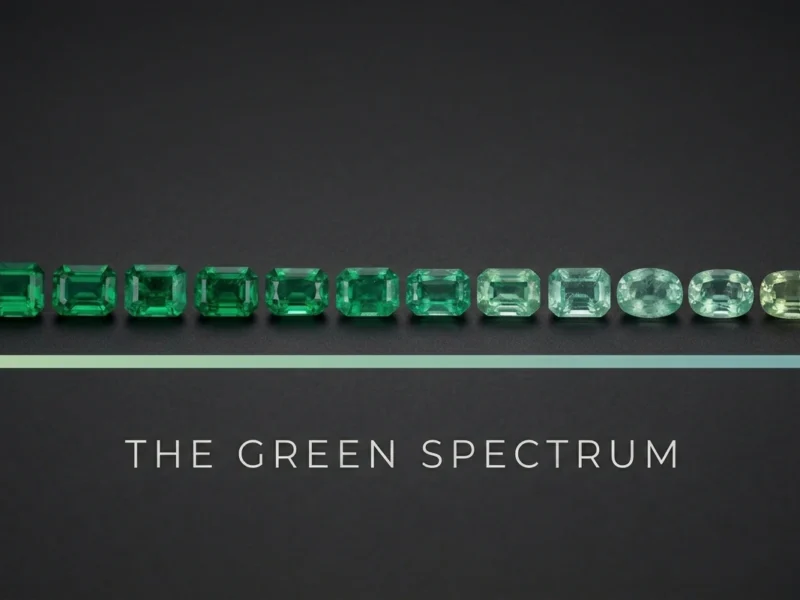

Green beryl and emerald are both the mineral beryl (Be₃Al₂Si₆O₁₈), but they are colored by different elements. Emerald is colored by chromium or vanadium, producing a vivid, warm green. Green beryl is colored by iron, producing a pale, desaturated teal. A GIA, Gübelin, or GRS certificate will state which one you have — and the price difference can be 50:1.
Place an emerald and a green beryl side by side. To the casual eye, both are green. Both are transparent. Both might sit in similar settings in a jeweler’s window. But the green beryl vs emerald distinction is one of the most commercially significant in the entire gemstone trade — because the laboratory certificate that separates them can represent a price difference of $200 per carat on one side and $30,000 per carat on the other.
This is not a subtle gemological technicality. It is a financial reality that affects every buyer who has ever looked at a green stone without understanding what beryl is and how its different varieties are classified. This guide covers the complete distinction: the mineralogy, the certification process, the price implications, and the three verification steps every buyer must take before any significant emerald purchase.
What Is Beryl? The Mineral Foundation
Before understanding green beryl vs emerald, it is necessary to understand what beryl is at the mineral level. Beryl is a beryllium aluminium cyclosilicate — chemical formula Be₃Al₂Si₆O₁₈ — that crystallizes in the hexagonal system. In its absolutely pure state, beryl is entirely colorless. Every colored variety of beryl gemstones — emerald, aquamarine, morganite, heliodor, red beryl — owes its color to trace elements that substituted into the crystal lattice during growth.
The beryl crystal structure contains a central channel running through its hexagonal ring that can accommodate atoms of different elements — chromium, vanadium, iron, manganese. Each element interacts differently with visible light, absorbing some wavelengths and transmitting others. The result is a mineral family that produces colors across almost the entire visible spectrum from a single base structure, with the specific color determined entirely by which trace element found its way into the crystal during formation.
Beryl crystals can grow to extraordinary sizes. The largest ever recorded — found in pegmatite rock formations — measured several meters in length and hundreds of kilograms in mass. What is rare is the right trace element in the right concentration in the right geological setting — which is why the most valuable beryl variety, emerald, commands prices that the others do not approach.
The Complete Beryl Mineral Family: Six Varieties, One Crystal
Six distinct gem varieties share the beryl structure, each colored by a different trace element, each occupying a different position in the commercial market.
Emerald — chromium and vanadium (the apex of the family)
The most commercially significant beryl gemstone. Colored by chromium, vanadium, or a combination of both — with chromium-dominant stones from Colombia commanding the highest prices in the global gem market. The specific visual quality of chromium in beryl — a warm, vivid, intensely saturated green — is the optical benchmark against which all other green gemstones are measured.
There is a threshold — debated in its precise placement across laboratories, but agreed upon in principle — below which a green beryl cannot be classified as emerald. Below it: green beryl, worth a fraction. At or above it: emerald, one of the most valuable gemstones in the world.
Aquamarine — iron (Fe²⁺) and the same mineral
The aquamarine vs emerald comparison illustrates the trace-element principle most dramatically. Both are beryl. Aquamarine is colored by ferrous iron (Fe²⁺), which produces a blue to blue-green color through a completely different light-absorption mechanism than chromium. Fine aquamarine commands strong prices in its own category — but on a per-carat basis, trades at a fraction of fine Colombian emerald. Same mineral family, different trace element, completely different market position.
Morganite — manganese (pink to peach)
Colored by manganese to a pink or peach tone. Fine material from Brazil and Madagascar. Became commercially fashionable in engagement ring settings from the 2010s onward as a lower-cost alternative to pink sapphire.
Heliodor — iron (Fe³⁺) (golden yellow)
Golden-yellow beryl colored by ferric iron — a different oxidation state from the ferrous iron that produces aquamarine. The same iron element that produces the pale blue of aquamarine produces the warm yellow of heliodor in a different oxidation state — a demonstration of how trace element chemistry drives the entire beryl color system.
Red Beryl — manganese (the rarest)
Found in significant quantities only in the Wah Wah Mountains of Utah, USA. Crystals are typically tiny — under 1 carat faceted — and heavily included. Per-carat prices among serious collectors can exceed even fine emerald for exceptional material.
Goshenite — colorless (pure beryl)
Beryl in its chemically pure state, without trace element substitution. Goshenite is the baseline from which every other beryl color departs — the proof that the mineral itself is colorless, and that everything we value is contributed entirely by trace elements.
| Variety | Color | Colorant | Key Source | Market Position |
|---|---|---|---|---|
| Emerald | Vivid green | Chromium + vanadium | Colombia, Zambia | Investment benchmark |
| Aquamarine | Blue to blue-green | Iron (Fe²⁺) | Brazil, Nigeria | Strong volume trade |
| Morganite | Pink to peach | Manganese | Brazil, Madagascar | Fashion / bridal |
| Heliodor | Yellow to gold | Iron (Fe³⁺) | Brazil, Namibia | Collector / specialty |
| Red Beryl | Deep red | Manganese | Utah, USA only | Collector / rare |
| Goshenite | Colorless | None | Global pegmatites | Negligible |
Green Beryl vs Emerald: The Commercial and Gemological Distinction
The green beryl vs emerald distinction is where the beryl mineral family becomes commercially critical — and where buyers, including many professionals, make errors of significant financial consequence.
What makes an emerald an emerald — the colorant threshold
What makes an emerald an emerald is a specific combination: sufficient chromium, vanadium, or both, to produce a color that GIA, Gübelin, and GRS classify as emerald rather than green beryl. Chromium in the beryl lattice absorbs light in both the yellow and blue portions of the visible spectrum simultaneously, leaving a uniquely pure, warm, saturated green in transmission. This simultaneous double absorption gives chromium-colored emerald its distinctive quality — no other element in the beryl system produces anything comparable in intensity.
Iron, by contrast, absorbs light in a narrower and less complete pattern, producing a pale, desaturated green with a slightly teal or bluish modifier. Same crystal, same formula, same structure — but a different trace element, a different optical result, and a completely different commercial object.
| Emerald | Green Beryl | |
|---|---|---|
| Mineral species | Beryl (Be₃Al₂Si₆O₁₈) | Beryl (Be₃Al₂Si₆O₁₈) |
| Colorant | Chromium (Cr) and/or vanadium (V) | Iron (Fe²⁺ or Fe³⁺) |
| Color character | Vivid, warm, saturated green | Pale, slightly teal, desaturated |
| Certificate wording | ‘EMERALD’ | ‘Green beryl’ or ‘beryl’ |
| Typical per-carat (3ct fine) | $15,000–$50,000+ | $200–$500 |
| Investment classification | Documented auction market | Commercial / ornamental |
A stone labeled ‘green beryl’ on a certificate is not a budget emerald. It is a different gemological object — and its market value reflects that difference completely.
The laboratory boundary — and why it is debated
The precise colorant threshold that separates green beryl from emerald is not identically defined across all major laboratories. GIA, Gübelin, and GRS each maintain their own classification criteria, applied through spectroscopic analysis combined with visual color assessment under standardized conditions. A stone on the borderline may receive different designations from different laboratories. For any purchase of financial significance, obtaining certificates from two independent laboratories on borderline material is not excessive caution — it is standard professional practice.
Why this matters — the 50:1 price ratio in practice
Consider two stones: a 3-carat green beryl of good clarity and transparency, and a 3-carat Colombian emerald of comparable clarity and transparency. They may look similar in a photograph. They may look similar to a casual viewer in a jewelry store. The price difference between them — $200–500 per carat versus $15,000–50,000 per carat — is not a margin. It is a categorical commercial distinction.
This distinction has consequences for buyers purchasing from non-specialist retailers, online platforms, estate sales, and even some auction houses where specialist gemological advice is limited. The certificate is the only reliable protection. A reputable dealer who cannot produce a GIA, Gübelin, or GRS certificate for a stone they are calling an emerald is either uninformed or concealing the designation.
Why Chromium Makes Emerald the Most Valuable Beryl Gemstone
Chromium is one of the most powerful colorants in mineralogy. In the beryl crystal lattice, chromium absorbs light simultaneously in the yellow region (around 600nm) and the blue region (around 420nm) of the visible spectrum. This simultaneous double absorption leaves a transmission window that is pure green — not greenish-yellow, not greenish-blue, but an exceptionally clean, warm green that the human eye perceives as vivid and saturated. No other transition metal element in the beryl system comes close to this intensity of color production.
Iron’s light absorption in beryl is different in character: narrower, less complete, producing a transmission that is desaturated and shifted toward blue-green. The difference is not one of degree. It is a difference in the physical mechanism of color production.
How to Verify — The Three Checks Every Buyer Must Make
The green beryl vs emerald distinction can be completely verified before any purchase decision through three sequential checks. None requires specialist gemological training. All require a certificate from a reputable laboratory.
| 01 |
The laboratory
The certificate must come from GIA (Gemological Institute of America), Gübelin (Switzerland), or GRS (Gem Research Swisslab). These three are the global standard for colored stone origin and variety determination. Regional labs, dealer appraisals, and in-house certificates do not provide equivalent protection.
|
| 02 |
The variety designation
The variety field on the certificate must read ‘EMERALD’ — not ‘green beryl,’ not ‘beryl,’ not ’emerald (green beryl).’ Any designation other than the unqualified word ’emerald’ indicates the stone does not meet the laboratory’s emerald classification threshold. The commercial consequence is categorical.
|
| 03 |
The colorant notation
For Colombian material, the certificate should note chromium and/or vanadium as the colorant. A certificate that notes iron as the primary colorant, even if the variety field reads ’emerald,’ indicates borderline material that may warrant a second laboratory opinion.
|
Frequently Asked Questions: Green Beryl vs Emerald
Is green beryl the same as emerald?
No — green beryl and emerald are not the same, despite being the same mineral species (beryl). The difference is the colorant. Emerald is colored by chromium or vanadium, producing a vivid, saturated green. Green beryl is colored by iron, producing a pale, desaturated, slightly teal green. GIA, Gübelin, and GRS classify them separately on certificates, and their commercial values differ dramatically — a 3-carat fine Colombian emerald and a 3-carat green beryl of comparable clarity can differ in price by 50:1 or more.
What makes an emerald an emerald and not green beryl?
What makes an emerald an emerald is the presence of chromium, vanadium, or both as the primary colorant, in sufficient concentration to produce the characteristic vivid emerald green. The gemological laboratories assess this through spectroscopic analysis — measuring the specific absorption pattern of the stone in visible light — combined with visual color evaluation. A stone that passes this threshold receives the ’emerald’ designation on its certificate. One that does not receives ‘green beryl’ or ‘beryl.’
How can I tell if my green stone is emerald or green beryl without a certificate?
Without a certificate from a reputable laboratory, it is not reliably possible to distinguish emerald from green beryl by eye — even for trained professionals. Both stones can appear similar in photographs, in casual viewing, and under many lighting conditions. The only reliable method is spectroscopic analysis performed by GIA, Gübelin, or GRS. For any stone of significant financial value, a certificate is not optional — it is the minimum documentation required to know what you own.
Is aquamarine the same mineral as emerald?
Yes — aquamarine and emerald are both the mineral beryl (Be₃Al₂Si₆O₁₈). The difference is the colorant: emerald is colored by chromium or vanadium (vivid green), while aquamarine is colored by ferrous iron Fe²⁺ (blue to blue-green). Aquamarine vs emerald is therefore not a question of which stone is ‘real’ — both are genuine beryl varieties. The value difference reflects the rarity of chromium-bearing formation conditions relative to the iron-bearing environments that produce aquamarine.
Why does green beryl cost so much less than emerald?
Green beryl costs significantly less than emerald because it is a different commercial object, not because it is inferior in quality. The chromium or vanadium colorant in emerald produces a visual result — the vivid, warm, saturated green that is the global gem trade’s benchmark — that iron simply cannot match. The geological conditions that produce chromium-bearing emerald are far more specific and rare than those that produce iron-colored green beryl. The price difference reflects both the optical superiority of the chromium colorant and the genuine geological rarity of the conditions required to produce it.