Commercial quality is the grading tier that describes the majority of natural emeralds sold worldwide. It refers to stones with moderate-to-weak colour saturation, inclusions visible to the naked eye, and typically moderate-to-significant clarity treatment. It is not a synonym for fake, synthetic, or low value — it is a real, natural emerald that simply does not reach the colour and clarity thresholds of the fine or investment-grade tiers above it.
“Commercial quality” is one of the most misunderstood terms in the emerald trade. Buyers often hear it and assume it means inferior, or worse, imitation. In reality it is a standard grading category used across the gemstone industry, sitting below fine and investment grade on the same natural-emerald quality scale. Most emeralds set in everyday jewellery, including a large share of what is sold internationally, fall into this category.
Understanding what actually defines commercial quality — rather than treating it as a vague catch-all — is what allows a buyer to know exactly what they are paying for, and to spot when a commercial stone is being priced or marketed as though it were something finer.
Defining the Tier: Where It Sits on the Quality Scale
Gemmologists generally describe natural emerald quality across three broad tiers: fine or investment grade at the top, mid or good commercial grade in the middle, and lower commercial grade at the entry level. Commercial quality is not one fixed standard — it is a range, and stones within it can vary noticeably from each other. What unites them is that each falls short of the fine-grade threshold on at least one of the core value factors: colour, clarity, or treatment level.
This makes commercial grade the largest category in the market by volume. It is the tier that supplies most fashion jewellery, mid-range engagement pieces, and accessible gift items, precisely because it offers a genuine, natural emerald at a price point the fine-grade tier cannot reach.
Colour — Present, But Not Vivid
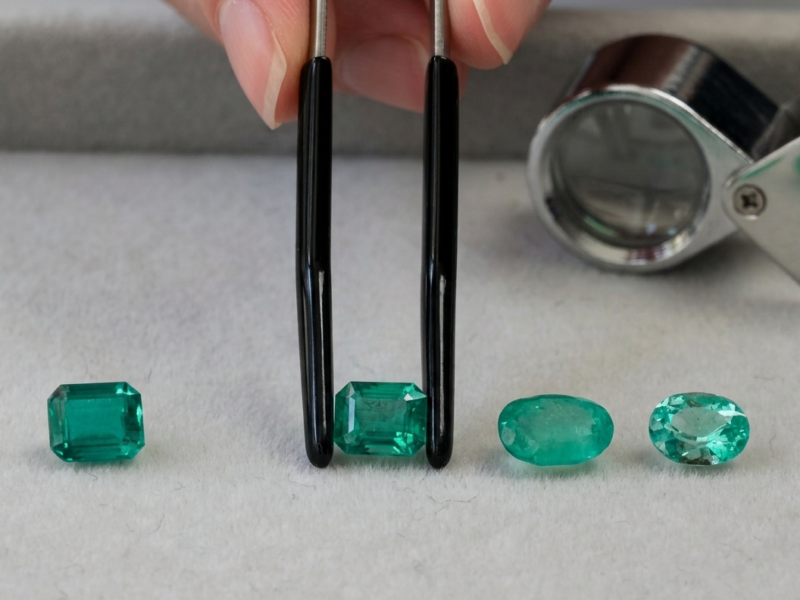
A commercial-grade emerald is still recognisably green. What separates it from fine material is saturation: rather than the vivid, intense green associated with the best Colombian stones, commercial saturation sits in the moderate-to-weak range. The colour reads as green without reading as vivid, and it often carries a visible grey or yellowish undertone that softens its intensity under normal light.
Tone in commercial stones tends to sit at the extremes rather than in the ideal medium range. A lighter commercial stone can look closer to pale mint than true emerald green, while a darker one can look blackish, with its colour only becoming visible under strong or direct light. Both patterns are typical of the category and are one of the fastest ways to identify it.
Saturation is the single factor buyers pay the most for, and it is exactly the factor that defines the ceiling of the commercial tier. A commercial stone can be perfectly well cut and set, but it will not carry the price of a vivid, high-saturation stone regardless of size.
Because commercial colour often looks acceptable under warm shop lighting, the most reliable check is neutral daylight, ideally unmounted, against a white background. A stone that only looks vivid under a ring-light is behaving exactly as commercial-grade colour is expected to behave.
Clarity — Visible Inclusions, Not Absent Ones
Every natural emerald has inclusions; the internal “jardin” is expected at every quality level and is part of what confirms a stone is natural rather than synthetic. What defines commercial clarity specifically is that these inclusions — fractures, feathers, or a denser jardin — are visible to the unaided eye at normal viewing distance, rather than only under magnification.
This gives commercial-grade stones a slightly less luminous, occasionally cloudy appearance compared to eye-clean fine material, even when the underlying colour is reasonably good. It is also where structural durability becomes a consideration: commercial stones with surface-reaching fractures require more careful handling in daily wear than a cleaner, fine-grade stone.
Hold the stone at arm’s length in daylight. If a fracture, whitish veil, or cluster of inclusions is immediately visible without a loupe, the stone is squarely within the commercial-clarity range — this is expected and normal for the category, not a sign of a poor stone.
Within the commercial tier itself, clarity varies widely. Upper commercial stones can be nearly eye-clean with only minor visible inclusions, while lower commercial stones carry a denser, more obviously included jardin. This internal range is why two commercial emeralds of the same carat weight can still differ meaningfully in price.
Treatment Level — Why It Runs Higher in This Tier
Nearly all emeralds, at every quality level, are treated with colourless oil or resin to fill surface-reaching fractures and improve apparent clarity. Minor treatment on its own does not define commercial grade. What does is the degree of treatment typically required to make a commercial stone presentable at the point of sale.
Because commercial stones start with more visible inclusions, they generally need moderate to significant treatment to reach an acceptable appearance — sometimes with resin or hardened fillers rather than traditional cedar oil. This is standard, disclosed practice in the trade, not a concealment of a defect. It does, however, mean commercial stones carry a lower ceiling for long-term treatment stability than lightly oiled fine material.
| Commercial Sub-Tier | Typical Colour | Typical Treatment |
|---|---|---|
| Upper Commercial | Moderate saturation, minor undertone | Minor to moderate oil |
| Mid Commercial | Weak-moderate saturation, visible grey/yellow | Moderate oil or resin |
| Lower Commercial | Weak saturation or extreme tone | Significant, often resin-filled |
Always ask for the treatment designation, not just the origin. Two commercial stones with identical colour can differ significantly in long-term durability depending on whether they were minor-oiled or resin-filled.
Origin and Documentation — Often Asserted, Rarely Certified
Commercial-grade emeralds are frequently sold without independent laboratory certification of origin. Where origin is mentioned, it is often stated by the seller rather than confirmed by a laboratory such as GIA, Gubelin, or GRS. This does not mean the stated origin is untrue — it means it has not been independently verified, which becomes relevant at resale, appraisal, or insurance.
Skipping formal origin certification is one of the ways commercial stones keep their price accessible; certification adds cost that is rarely justified for a stone already priced at the entry to mid-market level. Colombian, Zambian, and Brazilian emeralds can all fall within the commercial tier — origin alone does not lift a stone out of it.
Commercial quality is a legitimate, honest category — the issue only arises when a commercial stone is marketed with fine-grade language it hasn’t earned. Priced and described accurately, a commercial emerald is a genuine, natural gemstone and a reasonable way to own one.
Frequently Asked Questions
Is a commercial-quality emerald real?
Yes. Commercial quality describes a real, natural emerald with moderate-to-weak colour saturation and visible inclusions. It is a distinct classification from synthetic or lab-grown emeralds, which must always be disclosed as such on any certificate.
Why does treatment tend to be heavier in commercial stones?
Because commercial stones start with more visible inclusions, moderate to significant oiling or resin filling is typically needed to bring the stone to an acceptable, saleable appearance. This is standard, disclosed practice across the category rather than an attempt to conceal a defect.
Does commercial grade mean poor value?
No. It means accessible value. Commercial-grade emeralds make up the majority of the market and are the standard choice for fashion jewellery and mid-range pieces. The value question only becomes a problem when a commercial stone is priced as though it were fine or investment grade.
Can a commercial emerald still have a Colombian origin?
Yes. Origin and quality tier are separate. A Colombian-origin stone with weak saturation and heavy fracture-filling still sits in the commercial category, just as stones from Zambia or Brazil can. Country of origin does not by itself determine quality tier.
How can I quickly recognise commercial quality when viewing a stone?
View the stone unmounted, in neutral daylight, at arm’s length. If inclusions are immediately visible without magnification, or the colour looks grey, yellowish, or washed out outside of studio lighting, the stone is very likely commercial grade.