In the emerald market, inclusions are expected, accepted, and in the case of the finest Colombian material, celebrated. A completely clean emerald is not a premium stone — it is a suspicious one. The jardin is the geological certificate that no laboratory can fabricate.
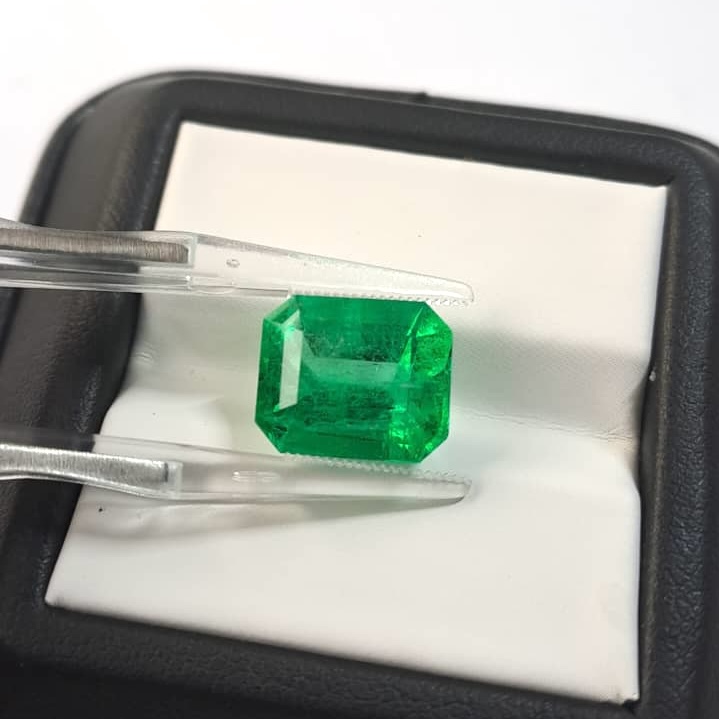
The first time many people look closely at an emerald — really closely, under magnification — their reaction is surprise at what they see. Where a diamond would be a window of pure transparency, an emerald reveals a world inside: needle-like crystals, irregular fractures, two-phase and three-phase inclusions that look like tiny landscapes of solid, liquid, and gas frozen in geological time. This is the jardin — the garden — and it is one of the most misunderstood characteristics in the entire gemstone trade.
The instinct to treat inclusions as imperfections, carried over from diamond education, is wrong when applied to emeralds. In the emerald market, inclusions are expected, accepted, and in the case of the finest Colombian material, celebrated — because what the inclusions represent, where they come from, and what they tell a gemologist about the stone’s origin and authenticity are all significantly more important than their visual presence.
What Is the Jardin?
The jardin is the collective term for the inclusions visible in a natural emerald — the internal landscape of crystals, fluids, fractures, and mineral particles that formed alongside the emerald during its millions of years of growth. The French word jardin (garden) was adopted by the trade because the inclusion landscape of a fine emerald, viewed under magnification, resembles a garden — irregular, organic, layered, different in every stone.
Mineral Inclusions
Solid mineral crystals trapped within the emerald during growth. In Colombian material, common mineral inclusions include pyrite (appearing as small, bright metallic flakes), calcite (white or transparent crystals from the hydrothermal vein environment), albite feldspar, and occasionally other beryl crystals. These inclusions are direct evidence of the formation environment — the specific minerals present in the Colombian black shale and hydrothermal vein system.
Fluid Inclusions — Two-Phase and Three-Phase
Perhaps the most diagnostically important inclusions in Colombian emeralds are the fluid inclusions — cavities that contain trapped fluid from the hydrothermal solution that grew the crystal. In Colombian material, these are characteristically three-phase inclusions: a cavity that contains simultaneously a solid mineral crystal, a liquid (typically a highly saline brine), and a gas bubble. Under magnification, the gas bubble moves visibly within the liquid when the stone is tilted.
Three-phase inclusions are the gemological signature of the Colombian formation environment — specifically the hydrothermal brine conditions in the black shale formation unique to the Eastern Andes. Gubelin and GRS use three-phase inclusion analysis as one of the primary tools for confirming Colombian origin. They are the stone’s geological fingerprint.
Fractures and Healed Fractures
Most natural emeralds contain fractures — small cracks that formed during the crystal’s growth or during tectonic events over its 65-million-year history. Many of these fractures have been healed — partially or fully sealed by later mineral deposition, leaving a jagged or feather-like internal surface. These healed fractures are normal in natural emerald and accepted in the trade. Fractures are also the primary reason most natural emeralds are oiled or resin-treated — the fracture network provides pathways for treatment agents that can improve apparent clarity by filling open fractures with material of similar refractive index.
Why Inclusions Are Normal and Expected
The geological formation environment that produces fine Colombian emerald — hydrothermal veins in carbon-rich sedimentary black shale — is inherently inclusion-producing. The rich mineral content of the formation fluids, the complex chemistry of the black shale, and the long growth period all create conditions under which mineral trapping, fluid entrapment, and fracturing are unavoidable.
A natural emerald with no inclusions visible under 10x magnification is genuinely unusual — so unusual that it warrants gemological investigation. Such a stone might be an exceptionally rare natural stone (possible but uncommon), a heavily treated stone in which fractures have been filled to near-invisibility, or a synthetic emerald. The last possibility is the most commercially important.
The Clarity Paradox — Synthetics and the Jardin
Synthetic emeralds — grown in laboratory conditions — can achieve significantly higher clarity than most natural stones, because the controlled laboratory environment produces fewer mineral contaminants and a less complex fluid chemistry than the natural formation environment. A perfect or near-perfect stone that lacks the characteristic Colombian jardin under magnification is a red flag, not a premium characteristic.
Contains characteristic jardin — three-phase fluid inclusions, mineral crystals, healed fractures. The jardin is organic, irregular, and unique to each stone. It is the geological record of 65 million years of formation and the primary tool for confirming natural Colombian origin.
Grown in weeks or months under controlled conditions. Achieves higher clarity than most natural material precisely because the messy geological reality that produces the jardin is absent. A suspiciously clean emerald warrants laboratory examination before any significant purchase.
The Jardin and Market Value
The emerald trade uses a clarity grading system that acknowledges the inherent inclusion character of the species. GIA uses eye-clean (no inclusions visible to the naked eye under normal conditions) as a benchmark rather than loupe-clean, because loupe-clean natural emerald is so rare as to be commercially anomalous at anything other than tiny sizes.
| Clarity Level | Market Impact |
|---|---|
| Eye-clean, fine color | Strongest per-carat premiums in the market |
| Minor inclusions, not detracting from beauty | Strong prices, reduced from eye-clean but significant |
| Moderate inclusions, fine color | Acceptable, particularly at larger sizes |
| Heavy inclusions detracting from transparency | Significantly reduced value regardless of color |
In the fine Colombian market, color consistently takes priority over clarity in the value hierarchy. A vivid, slightly included stone will typically outsell a strong-color, eye-clean stone of similar weight. This is the reverse of diamond valuation logic and catches many buyers unfamiliar with the emerald market by surprise.
Reading the Jardin — What a Gemologist Sees
For a gemologist examining a Colombian emerald, the jardin is not noise — it is data. The specific combination of inclusion types, their distribution, their mineral identity, and the presence or absence of three-phase fluid inclusions all contribute to the assessment of:
| 01 |
Geographic Origin
Colombian vs Zambian vs Brazilian vs other sources have characteristic inclusion assemblages. Three-phase inclusions are strongly associated with Colombian formation conditions. |
| 02 |
Degree of Treatment
The extent and character of fracture-filling oils or resins can be assessed through the inclusion landscape. The fracture network visible in the jardin reveals how treatment has or has not been applied. |
| 03 |
Natural vs Synthetic
The jardin’s organic complexity distinguishes natural formation from laboratory synthesis. The absence of a characteristic natural jardin in an otherwise attractive stone is a significant red flag. |
| 04 |
Formation History
Specific mineral inclusions can indicate formation temperature, pressure, and fluid chemistry — data points that contribute to a full gemological picture of where and how the stone formed. |
Oiling and the Jardin
The fracture network that the jardin includes is also the pathway through which most commercial emeralds are treated. The standard treatment is oiling: immersion in colorless oil (traditionally cedarwood oil, now often synthetic resins of varying stability) that fills open fractures and reduces their visibility by matching the refractive index of the emerald. Oiling is so universal in the emerald trade that it is considered routine and does not substantially reduce value when minor in extent.
Treatment disclosure is mandatory at reputable auction houses and gemological laboratories. GIA, Gubelin, and GRS all rate treatment extent on certificates — typically on a scale from none (no indications of treatment) to significant (extensive treatment).
An emerald with GIA “no indications of clarity enhancement” (no oil) designation at vivid Colombian origin is among the rarest commercial gemological objects available. The premium it commands at auction reflects that rarity accurately. No-oil material implies natural high clarity — rare — and unaltered condition, commanding the highest market premium of any clarity-related designation in the emerald market.
Frequently Asked Questions
What is the jardin in an emerald?
The jardin is the collective term for the internal inclusions visible in a natural emerald under magnification — a landscape of mineral crystals, fluid inclusions, fractures, and healed fractures that formed alongside the emerald during its geological growth. The French word for garden was adopted because the inclusion landscape is organic, irregular, and unique to each stone.
Are inclusions bad in an emerald?
No — inclusions in emerald are expected, accepted, and in fine Colombian material, evidence of authenticity. The emerald market uses eye-clean (not visible to the naked eye) as its clarity benchmark, not loupe-clean, because loupe-clean natural emerald is extremely rare. Heavy inclusions that reduce transparency or affect light movement do reduce value, but the presence of inclusions under magnification is normal and not a negative indicator.
What are three-phase inclusions and why do they matter?
Three-phase inclusions are cavities within an emerald that contain simultaneously a solid mineral, a liquid (typically saline brine), and a gas bubble. They are characteristic of the Colombian formation environment — the specific hydrothermal brine conditions in the Eastern Andes black shale system. Gemological laboratories including Gubelin and GRS use three-phase inclusion analysis as a primary tool for confirming Colombian origin. They are the stone’s geological fingerprint.
Does oiling an emerald affect its value?
Minor oiling does not substantially reduce value — it is so standard in the trade that it is considered routine and disclosed but not penalised. Significant oiling (rated as such on a GIA, Gubelin, or GRS certificate) does reduce value relative to untreated material of equivalent clarity. No-oil material commands the highest premiums in the market, particularly for investment-grade Colombian stones, because it implies natural high clarity and unaltered condition.