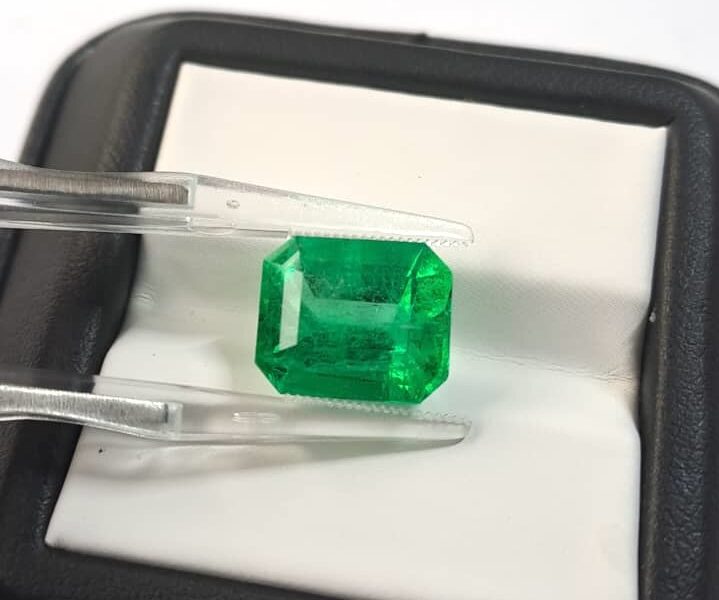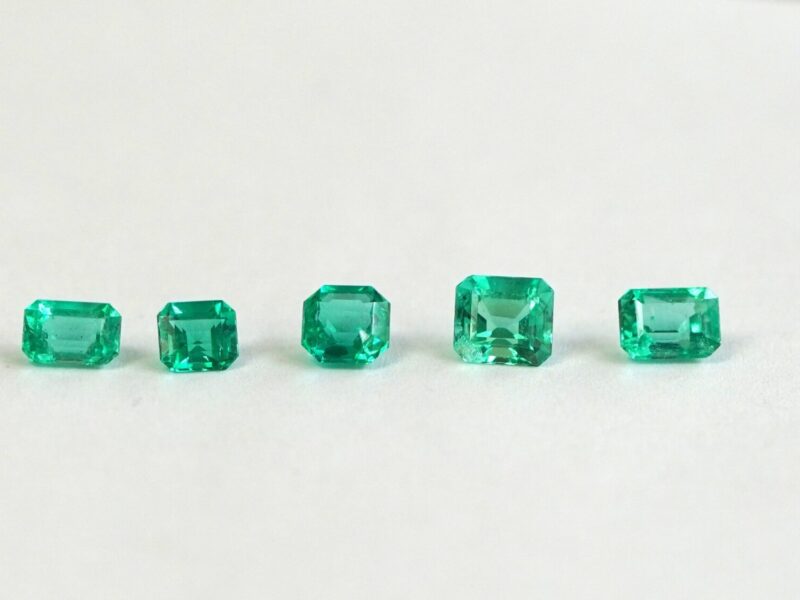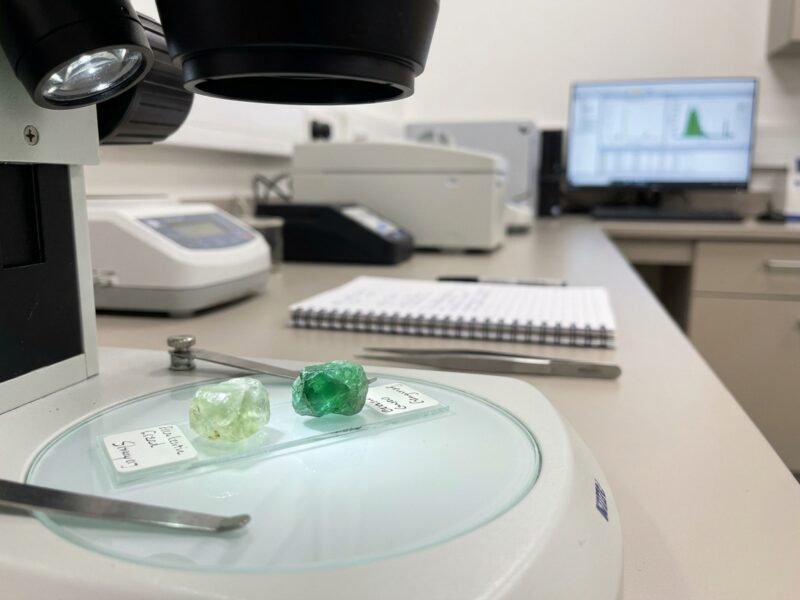

A high quality emerald is defined by five factors evaluated together: colour saturation and hue, transparency and internal luminosity, clarity and the character of its inclusions, treatment level, and certified geographic origin. No single factor tells the full story — the finest stones perform well across all five simultaneously, which is why they are genuinely rare.
Most buyers approach emeralds the way they approach diamonds — looking for a clean stone with good colour, and assuming the two are roughly equivalent in importance. They are not. Emerald quality assessment follows a different hierarchy, applies different standards to clarity, and treats one factor — origin — as a determinant that has no equivalent in diamond grading at all. Understanding that hierarchy is the difference between buying confidently and buying by appearance alone.
This guide covers every factor that defines a high quality emerald, in the order in which they matter commercially.
Colour — The Dominant Quality Factor
In diamond grading, cut is the primary value driver. In emerald grading, colour dominates — and it does so to a degree that has no parallel in any other major gemstone category. A vivid Colombian emerald with moderate clarity will consistently outsell a clean, well-cut stone with mediocre colour at the same carat weight. Colour, in this market, is not one factor among several. It is the foundation on which everything else is built.
Hue
The finest Colombian material sits in a range from pure green to slightly bluish-green — a clean, warm, neutral green without a strong yellowish or overly blue cast. Slightly yellowish stones read as warmer but less authoritative to trained eyes; strongly bluish stones, more common in Zambian material, are beautiful but occupy a different quality tier.
Tone
The commercial sweet spot for fine emeralds is medium to medium-dark — deep enough for richness, light enough to retain the transparency and internal brilliance that make a stone luminous rather than merely dark. A stone at the extreme dark end looks almost opaque under some lighting; one at the light end risks losing its emerald designation entirely.
Saturation — The Decisive Variable
Saturation is the intensity and purity of the colour — how vivid and clean the green appears versus how grey, brown, or muted it looks. The GIA designation of “vivid” — the highest saturation grade — is the single most valuable word on an emerald certificate.
A vivid grade at three carats can command two to five times the per-carat price of a strong-but-not-vivid stone of otherwise identical specification. No other grading designation produces a comparable value differential.
The Colombian colour standard — the benchmark against which the entire trade measures emerald quality — is the direct product of the Eastern Andes formation environment, which releases chromium in concentrations and chemical forms that other sources do not match. This is not a geographic preference. It is a measurable geochemical reality, confirmed by GIA and Gubelin spectroscopic research across decades of origin studies.
Transparency and Internal Luminosity
Transparency is the quality factor least discussed in popular guides and most immediately apparent to a trained eye in person. Two emeralds can carry identical colour grades on their certificates and look completely different when held to the light — because one has an internal luminosity that makes the colour seem to come from within the stone, and the other looks flat and inert.
A stone with good transparency and vivid colour appears to glow. The green is active, not passive. There is depth and movement to it. A stone with poor transparency — even with nominally correct colour — looks like a piece of green glass: the colour is there, but it sits on the surface rather than radiating from the interior.
The phenomenon called gota de aceite — drop of oil — found in the finest Muzo production, sits at the extreme end of this quality dimension. It is an optical effect produced by the specific density and distribution of microscopic inclusions in the highest-quality Muzo crystals, creating an internal silkiness that no other emerald source produces. Its presence is the hallmark of the finest Colombian material available.
This quality is assessed in person, in daylight, not from photographs. The finest stones have a transparency and internal life that no camera sensor reproduces accurately. The most experienced buyers in the world still insist on in-person evaluation before any significant commitment.
Clarity and the Jardin
Clarity in emeralds is evaluated by a different standard than in diamonds. For diamonds, the reference standard is loupe-clean. For emeralds, the practical standard is eye-clean — no inclusions clearly visible to the naked eye under normal viewing conditions. This is not a lower standard. It is an accurate reflection of what the natural formation environment produces. The same geological conditions that generate vivid chromium colour also produce the complex inclusion landscape called the jardin.
Three-phase inclusions — microscopic cavities containing a solid mineral crystal, a liquid brine, and a gas bubble simultaneously — are the geological fingerprint that laboratories use to confirm Colombian origin. They are the proof of natural formation. A completely clean emerald with no jardin under magnification is not a premium object — it is a suspicious one.
Eye-clean with fine colour: peak of the market. Minor inclusions under magnification only: strong commercial value. Moderate inclusions visible to the naked eye: acceptable in fine-colour material, especially at larger sizes. Significant inclusions affecting transparency: substantially reduced value regardless of colour.
Treatment Level — The Designation That Doubles Value
Most emeralds are treated. This is not a scandal or a secret — it is an accepted, disclosed, centuries-old practice. Oiling involves immersing the emerald in colourless oil or resin that fills open fractures and reduces their visibility. Minor oiling is so universal that it is considered standard and does not substantially affect price.
What affects price — dramatically — is the treatment designation on the laboratory certificate. GIA grades treatment extent on a four-level scale: none, minor, moderate, and significant.
| Treatment Level | GIA Wording | Market Impact |
|---|---|---|
| None (No Oil) | No indications of clarity enhancement | Highest premium — 2-3x minor oil price |
| Minor | Minor indications of clarity enhancement | Standard — does not substantially reduce value |
| Moderate | Moderate indications of clarity enhancement | Meaningful price reduction |
| Significant | Significant indications of clarity enhancement | Substantial reduction regardless of colour |
Always ask for the treatment designation before discussing price on any emerald of significance. A vivid stone with significant oiling and a vivid stone with no oil are not the same object, regardless of what they look like in a photograph.
Origin — The Factor With No Equivalent
Geographic origin is a value factor in the emerald market in a way that has no parallel in diamond grading. GIA does not add a premium for Canadian versus Botswana diamonds. The trade does add a premium — a substantial, documented, consistent premium — for Colombian versus Zambian versus Brazilian emeralds.
Colombian emerald formation is unique in the world: it occurs in a sedimentary host rock — black carbonaceous shale — rather than the igneous or metamorphic terrain that hosts every other major emerald source. This unique formation environment releases chromium in concentrations and chemical forms that produce a warmer, more intensely saturated green than any other source consistently achieves.
Associated with the finest vivid-green production and the gota de aceite phenomenon. From the Western Emerald Belt. The benchmark for the highest-saturation Colombian material at auction.
From the Eastern Emerald Belt. Tends toward a slightly more bluish-green hue associated with higher vanadium content. Both Muzo and Chivor designations are recognised on Gubelin certificates and carry their own premium structures.
A stone is not “certified Colombian” because a seller says it came from Colombia. It is certified Colombian because GIA, Gubelin, or GRS has analysed it and confirmed the geological signature of the Eastern Andes formation environment. That certificate is the only origin documentation that carries commercial weight.
The Five Factors Together — How to Think About Quality
Quality in emeralds is not a single score. It is the intersection of five variables, and the finest stones perform well across all five simultaneously — which is exactly why they are rare and why they are expensive.
| 1 |
Colour
Is the saturation vivid or approaching vivid? Is the hue in the Colombian green range? Is the tone medium to medium-dark? If the colour is not exceptional, nothing else compensates. |
| 2 |
Transparency
Does light move through the stone freely? Does it have internal luminosity, or does it look flat? This can only be assessed in person, in daylight. |
| 3 |
Clarity & Treatment
Is the stone eye-clean? What is the treatment designation? A no-oil eye-clean stone is significantly more valuable than a minor-oil stone with identical certificate grades. |
| 4 |
Origin
Does it carry confirmed Colombian origin from GIA, Gubelin, or GRS? For investment-grade consideration, origin certification from one of these three laboratories is the minimum documentation standard. |
| 5 |
Cut
Does the cut maximise face-up colour? Is the symmetry acceptable? Unlike diamond cut, there is no standardised grade — it is evaluated individually per stone. |
A stone that achieves vivid colour, good transparency, eye-clean clarity, no-oil treatment, and confirmed Colombian origin at meaningful carat weight is one of the rarest commercially available gemological objects in the world. That is not hyperbole. It is a direct consequence of the geological improbability of the conditions that produced it.
Frequently Asked Questions
What is the most important quality factor in an emerald?
Colour, and specifically saturation. The vivid designation from GIA, Gubelin, or GRS is the single most commercially decisive factor in emerald quality. No other characteristic compensates for mediocre colour, and no other characteristic produces a comparable value differential when it is exceptional.
Are high quality emeralds always free of inclusions?
No — and a completely inclusion-free emerald is suspicious rather than desirable. High quality natural emeralds always contain the jardin. What distinguishes fine material is that the jardin is manageable — the stone is eye-clean at normal viewing distance — not that it is absent. Absence of the expected jardin under magnification warrants investigation for synthetic origin or heavy treatment.
Is a Colombian emerald always better than a Zambian or Brazilian emerald?
Not categorically — but statistically, Colombian material achieves the highest saturation grades at a disproportionately higher rate than any other source, which is why the Colombian origin premium exists and persists. A fine Zambian stone can outperform a mediocre Colombian stone. The origin designation matters most at the investment grade, where the difference represents a documented, auction-confirmed value differential.
What certificate should I look for when buying a high quality emerald?
GIA, Gubelin, or GRS — the three laboratories that set the global standard for coloured stone origin and quality determination. For investment-grade purchases, a certificate from one of these three is the minimum documentation standard. For Colombian material at significant values, many serious buyers obtain certificates from two of the three independently.
How do I know if an emerald has been treated?
The laboratory certificate will state the treatment designation: none, minor, moderate, or significant. For GIA, the wording for untreated stones is “no indications of clarity enhancement.” Always ask for the treatment designation before discussing price on any emerald of significance. If a seller cannot produce a certificate from GIA, Gubelin, or GRS that includes a treatment designation, that absence is itself information.